How to Breed Amano Shrimp: Larvae, Salinity, and Realistic Odds
How to breed Amano shrimp at home: why the larvae die in freshwater, the salt water rearing method step by step, what to feed them, and honest success rates.
📅 Published 2026-10-19
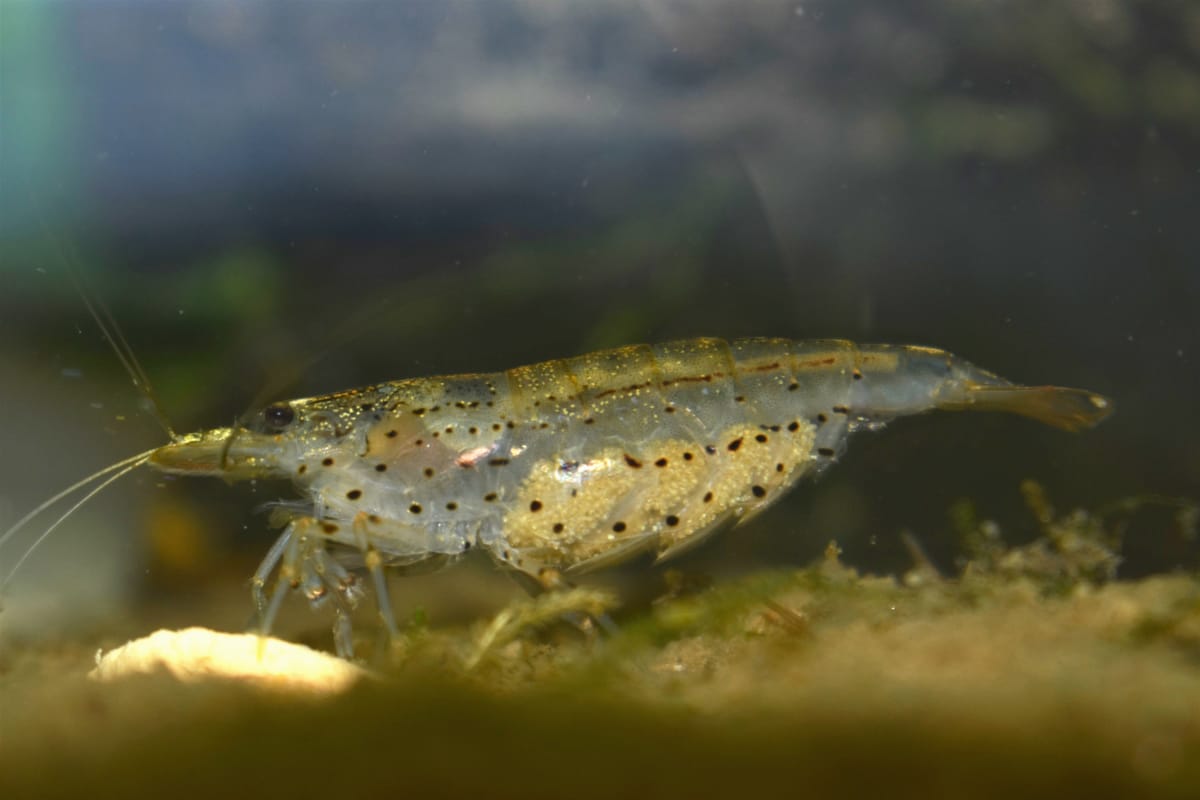
Your female Amano is carrying eggs again, and again nothing will come of it. If you want to know how to breed Amano shrimp, the first thing to accept is that it's not a matter of luck or patience. The larvae hatch into freshwater and then need salt water within a day or two, or they die. No amount of moss, biofilm, or careful feeding in a community tank changes that.
The good news is that people do it. The method has been worked out since the 1980s in Japanese aquaculture research and refined by hobbyists since. It needs a second small tank, marine salt, a refractometer, something green and microscopic for the larvae to eat, and about two months of fiddly daily attention. This guide lays out the whole process, tells you where the published advice contradicts itself, and gives you the numbers to decide whether it's worth your time.
Quick Answer
Amano shrimp (Caridina multidentata) breed in freshwater but their larvae must develop in salt water. Move a berried female to a bare tank when her eggs turn from green to brownish, collect the hatched larvae, and transfer them within 24 hours to a filterless, aerated tank of marine salt water. Published salinity targets range from 15 to 35 ppt. Feed the larvae phytoplankton, diatoms, or a pinch of spirulina, keep the water at 72 to 77F, and after 4 to 8 weeks they'll metamorphose into tiny shrimp that swim forward instead of drifting. Drip them back to freshwater within a day of that change. A 10 to 20 percent survival rate is a good result.
Why Amano Shrimp Never Breed in Your Tank
Cherry shrimp are direct developers: the eggs hatch into miniature shrimp that graze biofilm from the first day. Amano shrimp are amphidromous. Wikipedia's species page describes the cycle plainly: eggs are laid and hatch in freshwater, the newly hatched larvae drift to the sea, develop there, and return to freshwater as juveniles. In the wild that drift happens because Amanos live in fast coastal streams a short float from an estuary.
In a tank, the larvae have nowhere to go. They hatch, drift around for a few days looking like specks of dust with eyes, and die. Aquarium Co-Op's care guide puts it flatly: Amanos "are not capable of reproducing in regular freshwater tanks at all since their larvae require highly brackish or salt water to survive." Our Amano shrimp care guide covers the adult side; this article picks up where it leaves off.
The larvae are also nothing like shrimplets. They're planktonic, they hang head-down in the water, they swim toward light, and for the first stages they don't eat at all, living off yolk. Wikipedia notes they only start feeding in the third zoeal stage. They'll pass through a series of molts over several weeks before they turn into something you'd recognize as a shrimp.
That's the whole problem: to breed Amanos you have to run a small marine larval-rearing operation for about six weeks.
What You Need Before the Female Berries
Get this together before you need it, because once eggs are close to hatching you'll have a day, not a week.
- •A rearing tank. 10 to 20 liters (3 to 5 gallons) is plenty for one batch, and a clear plastic tub works. Bare bottom, no substrate, no plants.
- •Marine salt mix. The kind used for saltwater tanks. Every guide we read agrees: not table salt, not kosher salt, not "aquarium salt" sold for freshwater fish. Those lack the minerals the larvae need. A search for marine aquarium salt mix turns up the usual brands.
- •A refractometer. Floating hydrometers are too crude for this. A cheap salinity refractometer costs less than a group of Amanos.
- •An air pump and airline. No filter of any kind; the larvae get pulled into a sponge. A Tetra Whisper air pump with an open airline set to a slow bubble is enough.
- •A heater, unless your room sits at 72 to 77F on its own, and a light you can leave on.
- •Larval food. Live phytoplankton, a green water culture, spirulina powder, or a fine fry food in the 50 to 100 micron range.
- •A pipette or turkey baster for moving larvae.
Mix the salt water a day ahead so it's fully dissolved, and let the rearing tank sit under light for a week or two if you can. Noren and The Shrimp Farm both note that a tank that has grown a film of diatoms on the walls feeds the larvae on its own.
The Salinity Question: Sources Disagree
This is where Amano breeding guides split, and it matters enough to spell out. Here's what six sources recommend for the larval tank:
| Source | Salinity | Specific gravity |
|---|---|---|
| Hayashi and Hamano, 1984 (Japanese study, as reported by breeder Mike Noren) | 17 ppt, about 80 percent survival | about 1.012 |
| Mike Noren (hobbyist, 2009 write-up) | 30 to 35 ppt, about 80 percent survival; heavy losses below 30 | 1.022 to 1.026 |
| The Shrimp Farm | 30 to 35 ppt | 1.022 to 1.026 |
| Gensou Aquascaping | 15 to 17 ppt | 1.011 to 1.013 |
| Aquascaping Academy | 15 to 20 ppt | not given |
| AquariumInfo | 17 to 35 ppt all workable | not given |
So a Japanese study found half-strength seawater best, and a careful hobbyist who tried to replicate it lost nearly everything below 30 ppt and got his 80 percent at full marine strength. Two retailers split the same way. Some keepers on hobby forums report that Amanos sold in the trade come from more than one source population, with one type doing best in brackish water and others needing full seawater, which would explain the spread. We only found that idea in forum discussion, so treat it as a hypothesis rather than a fact.
The practical takeaway: both ends of the range have produced live juveniles for someone. If your larvae are dying off in the first week or two at one salinity, the next batch is your chance to try the other. Whichever you pick, keep it steady. Top up evaporation with freshwater, not salt water, or the salinity will creep upward every day.
One thing the sources do agree on: the eggs themselves hatch in freshwater. Noren lost two batches by moving berried females into brackish water, where the eggs never hatched. The female stays in freshwater; only the larvae move.
Step by Step: From Berried Female to Larvae
1. Watch the egg color. A female carries her eggs for somewhere between 3 and 6 weeks depending on temperature and the source you read (The Shrimp Farm says 3 to 5 weeks, Gensou 4 to 6, Aquascaping Academy 5 to 6). Fresh eggs are green. As they ripen they shift to brownish or grayish, and in the last few days you can sometimes see eye spots. That color change is your cue.
2. Move the female to a hatching container. A small bare tub of her own tank water, an airline, and a piece of moss to cling to. Do this when the eggs go dark, not before, because a stressed female may drop eggs early.
3. Wait for the hatch. Larvae appear as tiny specks drifting in the water. Shine a flashlight at one corner and they'll gather toward it, which makes them easy to collect. Return the female to the main tank once she's empty.
4. Move the larvae to salt within 24 hours. Every guide gives the larvae a day or so of tolerance in freshwater, and Gensou puts the deadline at 12 to 24 hours. Pipette them out and into the salt water. Some breeders drip the salt water into the hatching container over an hour first; others transfer directly and report no losses. If you're nervous, drip.
5. Set the rearing tank going. Slow aeration, 72 to 77F (Noren ran about 77F and says temperature isn't critical within that band), and light. Now the waiting starts.
For the mechanics of how a female gets berried in the first place, our how do shrimp reproduce guide covers saddles, molting, and mating. It's the same for Amanos; only what happens after the hatch is different.
Feeding the Larvae
Amano larvae are filter feeders that graze on whatever microscopic food drifts past or coats the tank walls. The sources converge on a few options.
Diatoms and green water. The original Japanese study reared larvae on adhesive diatoms and a grated artificial diet mixed with rice bran. Noren found diatoms, the brownish dust that grows on a lit tank's walls, to be the most important food and says it showed up on its own under constant light. A green water culture (a jar of tank water left in a sunny window until it turns green, or a bottle of live marine phytoplankton such as Nannochloropsis) does the same job in the water column. Gensou and Aqua-Fish both put phytoplankton first.
Spirulina powder. The Shrimp Farm's standby: a small pinch, and they mean small. It clouds the water and feeds bacteria as much as larvae if you overdo it.
Fine fry foods. Noren used Golden Pearls in the 50 to 100 micron range; AquariumInfo suggests micro-encapsulated fry food between 30 and 120 microns. Brewer's yeast in tiny amounts appears in both as a cheap option.
What not to feed. Baby brine shrimp. Noren found Artemia outcompeted the larvae for food. And don't feed heavily at all. The Shrimp Farm goes as far as saying supplemental feeding isn't necessary in a tank with good algae growth, because overfeeding fouls the water faster than anything else. Ammonia in a filterless tank has nowhere to go. Feed a little, two or three times a day, and do small water changes with pre-mixed salt water at the same salinity.
The light debate. The Shrimp Farm and Noren keep the light on 12 to 24 hours a day so algae and diatoms grow. Aquascaping Academy suggests subdued light in the early stages. The 24-hour camp has the better documented results, but if your larvae are crowding one corner and getting battered by the bubbles, dim it.
Metamorphosis and the Trip Back to Freshwater
Somewhere between day 25 and day 60, the larvae change. Guides give the window differently (Aquascaping Academy 25 to 45 days, Noren and AquariumInfo 30 to 60, Gensou 4 to 8 weeks), but the sign is the same everywhere: instead of drifting head-down or hanging in the current, a larva suddenly swims forward in quick bursts, and then settles on the glass or bottom and starts walking. It now looks like a tiny, transparent shrimp about 8 mm long. That's a postlarva, and it's on the clock.
Postlarvae can't take salt for long. AquariumInfo says they'll die within 48 hours at full larval salinity, and Noren says they must be moved immediately. As soon as you see forward-swimming shrimp, start moving them down. Two approaches:
- •Drip them into freshwater. Net or pipette the postlarvae into a container of their salt water and drip dechlorinated freshwater in, the way you'd acclimate a new shrimp, until the salinity is under 2 ppt. Guides span 6 to 8 hours (Gensou), 24 to 36 hours (The Shrimp Farm), and 24 to 48 hours (Aquascaping Academy). Somewhere in the middle, 12 to 24 hours, is a reasonable compromise.
- •Step the whole tank down. If most of the batch changes at once, AquariumInfo's method is to lower the tank to 15 ppt, then 5 ppt, over a few days, catching the stragglers that haven't changed yet as you go. Noren suggests dropping to 17 ppt when the first larvae start to metamorphose, which gives late larvae a chance and early postlarvae some relief.
Once they're in freshwater, they're shrimplets and you can treat them like any other. A bare or lightly planted grow-out with biofilm, a sponge filter, and no fish is ideal. Our how to raise shrimplets guide applies from here on. Growth is fast: Noren's reached 25 mm, sale size, by day 127 from hatching, and AquariumInfo puts sexual maturity at 3 to 5 months.
Realistic Numbers
Here's what to expect, drawn from the sources above.
| Stage | Number |
|---|---|
| Eggs per female per clutch | 1,000 to 3,000 (Gensou, AquariumInfo) |
| Eggs carried | 3 to 6 weeks |
| Larvae to metamorphosis | 25 to 60 days |
| Survival, typical hobbyist | 1 to 30 percent (Aquascaping Academy); 10 to 25 percent (The Shrimp Farm) |
| Survival, "a good result" | 10 to 20 percent (Gensou, Aquascaping Academy) |
| Survival, best documented | about 80 percent (Hayashi and Hamano at 17 ppt; Noren at 30 to 35 ppt) |
| Hatch to sellable size | about 4 months |
Even a 10 percent survival on a 1,000-egg clutch is 100 Amanos, more than most of us have tank space for. The realistic failure mode is zero. A first attempt that loses every larva in week two is common, and The Shrimp Farm is honest that "not many aquarists can do it." Noren's early attempts at low salinity produced 3 survivors from over 200 larvae before he switched. Expect to fail once before it works.
Is It Worth It?
Financially, no. Amanos cost a few dollars each, a group of 6 lasts years, and by the time you've bought salt, a refractometer, a pump, and a phytoplankton culture, you've paid for more shrimp than you'll ever raise.
As a project, it depends on what you enjoy. You'll learn to use a refractometer, culture green water, and watch a metamorphosis that most aquarists never see. If that appeals, it's one of the more interesting things you can do with a 5 gallon tub. If what you actually want is a self-sustaining colony, breeding cherry shrimp gives you that with none of this.
Females can berry every few weeks, so you don't have to catch every batch. Pick one, give it your full attention, and let the rest go.
Frequently Asked Questions
◆Can Amano shrimp breed in freshwater?
The adults mate and the eggs hatch in freshwater, but the larvae die within days unless they're moved to salt water. That's why berried Amanos in a community tank never produce babies. Breeding them means rearing the larvae in a separate marine tank for 4 to 8 weeks and returning the young shrimp to freshwater.
◆What salinity do Amano shrimp larvae need?
Published targets range from 15 to 35 ppt. A 1984 Japanese study got its best survival at 17 ppt, while breeder Mike Noren and The Shrimp Farm recommend 30 to 35 ppt, full seawater strength. Both have worked for someone. Use marine salt mix, measure with a refractometer, and hold whatever you choose steady.
◆How long do Amano shrimp carry eggs?
Between 3 and 6 weeks depending on temperature and the source you read. Eggs start green and turn brownish or gray as they ripen, and eye spots may show near the end. Move the female to a hatching container once the eggs darken, and expect larvae within about a week.
◆What do Amano shrimp larvae eat?
Phytoplankton, diatoms, and other microscopic food. Green water, live marine phytoplankton, a tiny pinch of spirulina powder, or fine fry food in the 50 to 100 micron range all work. Feed lightly two or three times a day, because uneaten food in a filterless tank fouls the water fast.
◆How do you acclimate Amano larvae back to freshwater?
Once a larva starts swimming forward in bursts and walking on the glass, drip dechlorinated freshwater into its container until salinity drops below 2 ppt. Guides suggest anywhere from 6 to 48 hours. Postlarvae die within about two days at full salinity, so don't delay once you see the change.
The Bottom Line
Amano shrimp won't breed in your community tank because their larvae need salt water, and no setup change fixes that. The real method is a bare, filterless marine rearing tank at somewhere between 15 and 35 ppt, larvae moved in within a day of hatching, phytoplankton or diatoms to eat, and a careful drip back to freshwater the moment they start swimming forward. Ten to twenty percent survival is a win, a first-try wipeout is normal, and it's never going to be cheaper than buying Amanos. Do it because you want to see it happen. If you're set on it, read our how to acclimate shrimp guide first, because the drip at the end is where a good batch is most often lost.
Found this helpful?
Check out our other shrimp care guides