How to Raise Shrimplets: Keeping Baby Shrimp Alive Past Week One
Baby shrimp survive or die in their first two weeks, and it comes down to biofilm, filter safety, and leaving the tank alone. Here's what actually works.
📅 Published 2026-09-05
Your first berried female hatched and for a few days you saw tiny specks everywhere. Now you're counting and there seem to be far fewer. This is the most common experience in shrimp breeding, and the causes are almost always the same handful of things.
Quick Answer
Shrimplets need three things: enough biofilm to graze continuously, a filter that can't suck them in, and to be left alone. They emerge fully formed, with no larval stage in Neocaridina and most Caridina, and they start feeding within hours.
Losses in the first two weeks are usually biofilm shortage in a tank that's too new or too clean, a filter intake without a guard, or parameter swings from over enthusiastic water changes. Nothing you add to the tank fixes these as well as maturity and patience.
What Actually Happens at Hatching
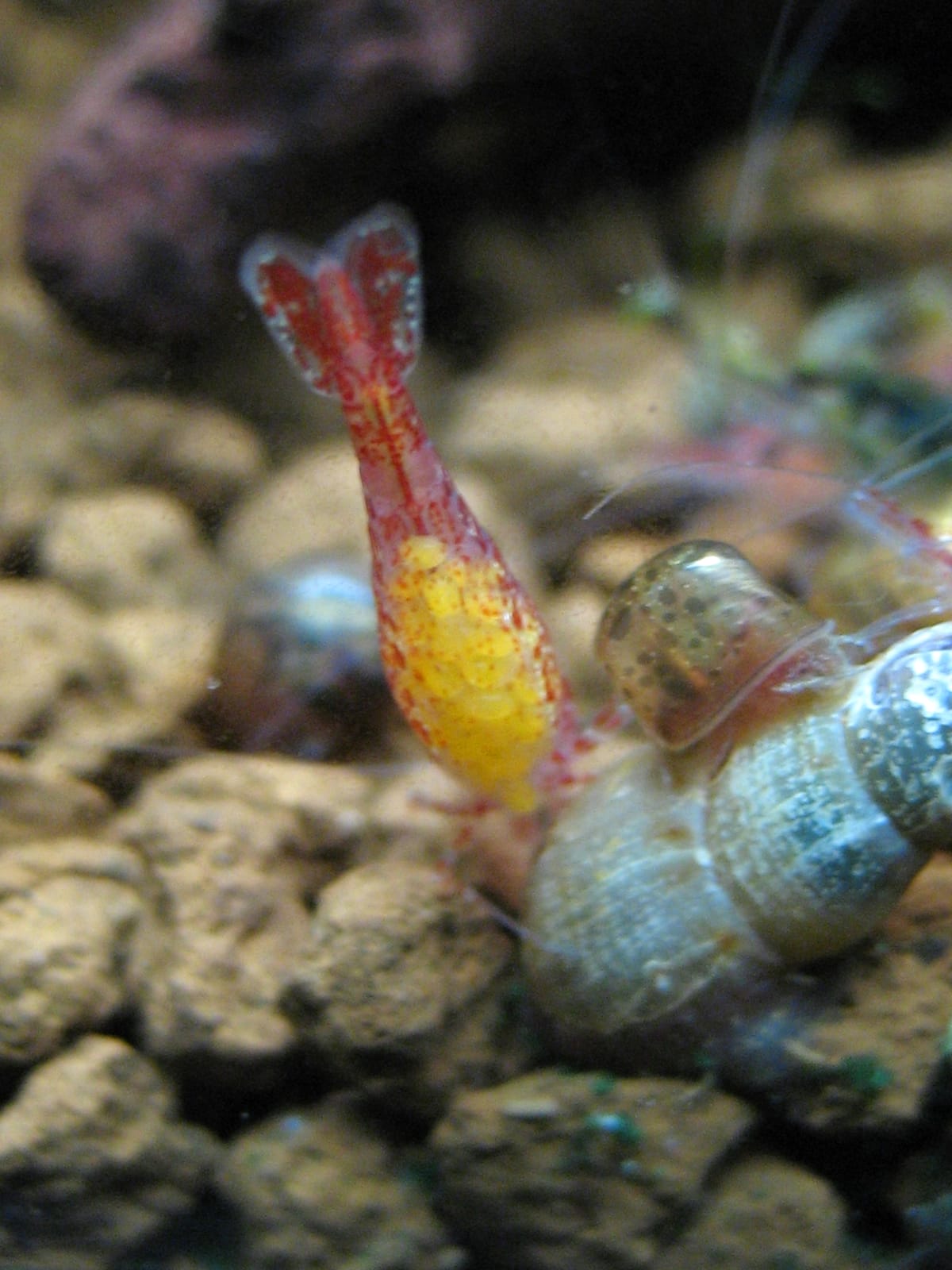
Dwarf shrimp like cherry shrimp are low order breeders with direct development. A berried female carries 20 to 30 eggs under her swimmerets for roughly three to four weeks, fanning them continuously to keep them oxygenated. The eggs develop visibly over that time, and in the final days you can often see tiny eyespots.
When they hatch, out come miniature shrimp. Not larvae. Not free swimming plankton. Fully formed shrimp about 2mm long that look exactly like the adults and behave the same way.
This is a huge practical advantage, and it's why Neocaridina are the beginner's breeding shrimp. Species like amano shrimp and pinocchio shrimp release planktonic larvae that need brackish water, which is why they effectively can't be bred at home. Our guide on how shrimp reproduce covers the difference in detail.
Shrimplets begin grazing within hours of hatching. There's no yolk sac period and no window where they don't need food.
The Single Most Important Thing: Biofilm
Shrimplets eat biofilm almost exclusively for their first few weeks. Biofilm is the invisible layer of bacteria, algae, and microorganisms that coats every surface in an established tank. It's what shrimp are grazing when they appear to be picking at nothing.
Adults can eat a food pellet. Shrimplets can't. They're too small to handle prepared food and they need to graze continuously off surfaces.
This is why shrimplets die in new tanks. A tank cycled six weeks ago has enough bacteria to process ammonia but not enough accumulated biofilm to feed a hundred babies grazing around the clock.
Give the tank time. Three months minimum before you expect good shrimplet survival, and six is better. A mature tank is the single biggest predictor of success.
Maximize surface area. Biofilm grows on surfaces, so more surface means more food. Moss is the best value here by a wide margin: java moss creates enormous surface area, traps particles, and gives shrimplets cover at the same time. Our guide on the best moss for shrimp tanks covers the options.
Add botanicals. Indian almond leaves, cholla wood, and alder cones all break down slowly and grow biofilm continuously. A tank with leaf litter feeds shrimplets without you doing anything.
Don't over clean. Scrubbing every surface removes the food supply. Leave the back glass, leave hardscape alone, and vacuum only open substrate.
Consider a powdered food. Powdered biofilm supplements are made for this. Use sparingly, since overfeeding fouls water faster than shrimplets can eat.
Filter Safety
The second reliable killer. A hang on back filter or a canister with an unguarded intake will draw shrimplets in, and they don't come back out alive.
Sponge filters are the standard answer. An air driven sponge filter has no intake to speak of, provides biological filtration, and the sponge itself becomes a prime grazing surface. Shrimplets colonize sponge filters and feed on them constantly. If you're breeding shrimp, this is the filter to use. Our guide on filters for shrimp tanks covers the choices.
If you must use a HOB or canister, guard the intake. A pre filter sponge over the intake is essential, not optional. They're inexpensive and they solve the problem completely. Our guide on canister filters for shrimp tanks covers the setup.
Check flow. Strong current exhausts shrimplets. Gentle circulation is enough.
Leave the Tank Alone
The third factor, and the hardest for new breeders. Shrimplets are far more sensitive to parameter swings than adults.
Reduce water changes. During the first weeks after a hatch, smaller and less frequent is better. Ten percent weekly is plenty in an established, lightly stocked tank. Large changes swing TDS and temperature, which triggers failed molts in shrimp that are molting frequently as they grow.
Match new water carefully. Temperature and TDS should match the tank before water goes in. Drip it slowly rather than pouring.
Don't chase perfect numbers. Stability beats precision. A tank held steadily at slightly imperfect parameters will out breed one that's constantly adjusted toward ideal. Our guide on shrimp water parameters covers what actually matters.
Don't rescape. Moving hardscape and replanting during a hatch destroys biofilm and crushes shrimplets. Save it for later.
Don't vacuum deeply. Shrimplets live in the substrate and mulm. Aggressive vacuuming removes both them and their food.
Minerals and Molting
Shrimplets molt frequently as they grow, and every molt needs minerals from the water. GH is the parameter that matters most.
For Neocaridina, GH 6 to 8 is a reasonable target. For Caridina, GH 4 to 6. Too low and you'll see failed molts. A GH and KH test kit tells you where you stand.
If you're using RO water, remineralizing correctly is essential rather than optional. Our guide on the best remineralizer for shrimp covers products, and tap water vs RO water covers whether you need RO at all.
Our shrimp molting guide covers the process and how to spot a failed molt.
Predation
In a species only tank, shrimplets have no predators. In a community tank, almost everything eats them.
The uncomfortable truth is that most fish considered "shrimp safe" are safe for adults and lethal to babies. A fish that can't fit an adult cherry shrimp in its mouth can very easily fit a 2mm shrimplet. Our guide on what fish eat shrimp covers this honestly.
If you want a growing colony, the reliable approach is a dedicated shrimp tank. If you want shrimp in a community tank, expect the colony to hold steady rather than grow, since shrimplet survival will be near zero.
Dense moss helps considerably by giving babies somewhere fish can't follow, but it doesn't fully solve the problem.
The one predator worth naming beyond fish is planaria, which do hunt shrimplets. Our guide on planaria and hydra covers identification and safe treatment.
A Realistic Timeline
Days 1 to 3. Shrimplets are almost invisible, around 2mm and often transparent. Most keepers see very few. They're hiding in moss and substrate, which is exactly what they should do.
Week 1 to 2. The critical window. Losses concentrate here. Do nothing dramatic.
Week 3 to 4. Survivors become visible as small versions of the adults. Colour starts developing.
Week 6 to 8. Recognizably juvenile shrimp, grazing openly, taking prepared foods.
Month 3 to 5. Sexual maturity. Females start showing saddles, and the cycle restarts.
A healthy colony roughly doubles every few months once established. Our guide on how long cherry shrimp take to colonize sets realistic expectations.
What Not to Do
Don't add more food to help. Overfeeding is the most common well intentioned mistake. Excess food fouls water and drives pest blooms without helping shrimplets, who need grazing surface rather than more pellets.
Don't move shrimplets. Netting and transferring babies causes losses. Leave them where they hatched.
Don't add anything to the tank. No new fish, no treatments, no supplements you haven't used before. Copper based products kill invertebrates at doses fish tolerate, and this bears repeating every time.
Don't count and panic. Shrimplets hide. A tank that looks empty often has plenty of babies in the moss. Judge by what emerges at week three.
Sexing Juveniles
Around the two to three month mark you can start telling males from females, which matters if you're planning to separate lines or want to know your ratio.
Females develop a deeper, broader abdomen with more curved side plates, the shape that holds a clutch of eggs. They grow larger overall and usually show stronger colour. The clearest early sign is a saddle, the patch of developing eggs visible through the carapace behind the head.
Males stay slimmer and straighter along the underside, remain smaller, and are typically less intensely coloured.
Juveniles under two months are difficult to sex reliably and there's no reason to try. Colour intensity is not a reliable indicator on its own, since it varies with genetics and stress.
For anyone building a colony, the ratio matters less than people assume. Dwarf shrimp breed readily and a group of ten or more will sort itself out. Our guide on how shrimp reproduce covers the mating process.
Frequently Asked Questions
◆How long do shrimplets take to grow up?
Roughly three to five months to sexual maturity for Neocaridina, depending on temperature and food. Warmer water speeds growth but shortens lifespan. They're recognizably juvenile shrimp by six to eight weeks.
◆Why did all my baby shrimp disappear?
The usual causes are insufficient biofilm in a tank that's too new or too clean, an unguarded filter intake, parameter swings from large water changes, or predation from tank mates. In a mature species only tank with a sponge filter and dense moss, survival is normally good.
◆Do I need to feed baby shrimp separately?
Not usually. In an established tank with moss and botanicals, biofilm feeds them without intervention. Powdered biofilm foods can help in newer tanks, but the underlying fix is tank maturity rather than added food.
◆Can shrimplets survive in a community tank?
Rarely in numbers. Most fish that are safe with adult shrimp will still eat 2mm babies. Dense moss improves the odds but doesn't solve it. A dedicated shrimp tank is the reliable way to grow a colony.
◆Should I move the berried female to a separate tank?
Generally no. Moving a berried female stresses her, and stressed females frequently drop their eggs. Adults don't hunt their own young in a well fed tank. Leave her where she is and let the shrimplets hatch into the established tank.
The Bottom Line
Raising shrimplets is mostly about restraint. Mature tank, dense moss and botanicals, sponge filter, small infrequent water changes, correct GH, and no fish that eat babies. Then leave it alone.
The instinct to intervene, to feed more, to test more, to move things around, is what kills most first batches. Get the environment right before the eggs hatch and the shrimplets largely take care of themselves. For the breeding side, our guide on breeding cherry shrimp covers getting to that first berried female.
Found this helpful?
Check out our other shrimp care guides