Is My Shrimp Dead or Molting? How to Tell the Difference
Is my shrimp dead or molting? An empty molt is see through and hollow, a dead shrimp stays solid and opaque. The fast checks in order, and what to do next.
📅 Published 2026-11-05
You walk up to the tank and there's a shrimp lying on the substrate, pale and still, with other shrimp crawling over it. Your stomach drops. Then you remember reading that shrimp shed their shells, and now you have no idea whether you're looking at a dead pet or the empty jacket it climbed out of an hour ago.
This is one of the most common panics in the hobby, and the good news is that it's usually the harmless answer. If you're asking whether your shrimp is dead or molting, there's a single test that settles it in about five seconds, and a dead shrimp looks different enough from a shed shell that you'll rarely be wrong once you know where to look. Here's how to tell them apart, why color will trick you, and what to do in each case.
Quick Answer
An empty molt is see through and hollow. A dead shrimp is solid and opaque. That one difference is the fastest and most reliable check: look closely, and if you can see straight through the shape and there's no body inside, it's a molt, and your shrimp is fine and hiding somewhere while its new shell hardens.
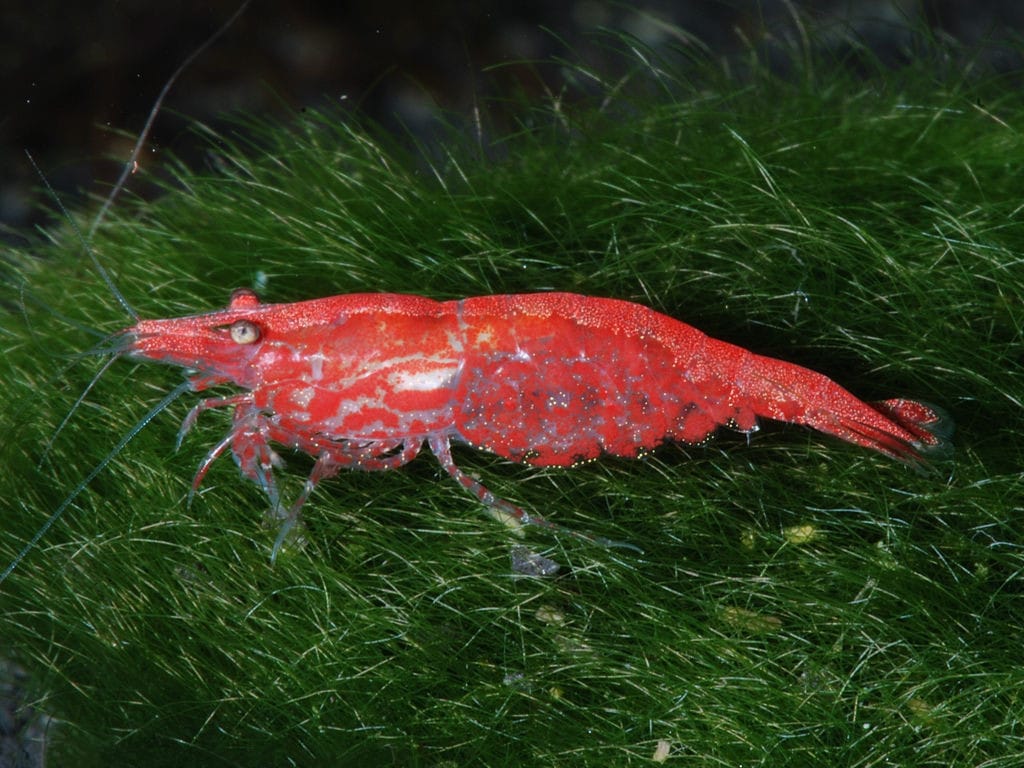
A dead shrimp keeps its body. It stays filled out, turns opaque, and often goes pink, orange, or milky white, the way a cooked shrimp does. It won't have the clean split just behind the head that a molt always shows. Color on its own is unreliable, because molts can look whitish too, so judge by whether the shape is hollow or solid. When in doubt, count your colony and give any motionless shrimp a gentle nudge before you assume the worst.
Why This Trips Up Almost Everyone
Shrimp grow by molting. Their shell doesn't stretch, so every few weeks they crack it open, back out, and leave the old one behind. Shrimp Science puts the rhythm at roughly every 3 to 4 weeks for adults and every 1 to 2 weeks for juveniles that are still growing fast. Skf Aquatics notes that very young shrimp can shed almost daily. In a colony of any size, there's an empty shell turning up on the glass or in the moss most days of the week.
The shed shell keeps the exact shape of the shrimp. Same legs, same antennae, same curled posture. From across the room it reads as a shrimp lying on its side, and your eye fills in the rest. Add in the other shrimp swarming it, and the scene looks like a death and a feeding frenzy when it's really a colony tidying up a pile of calcium. That's the trap. The molt is a perfect, empty copy, and it shows up far more often than an actual death does.
The One Test That Settles It: Hollow or Solid
Get close, or scoop the shape into a cup of tank water and hold it up to the light. Ask one question: can you see through it?
An empty molt is translucent and hollow. Keepers on nano-reef and petshrimp describe the same thing again and again. A shed exoskeleton is see through, with nothing inside, because the animal already walked away from it. One long time forum member's rule of thumb is that anything translucent is almost certainly a molt, since a corpse doesn't turn transparent.
A dead shrimp is the opposite. The body is still in there. It's solid, you can't see through it, and it has weight and substance when you study the abdomen and head. If the shape is filled out and opaque, you're looking at the shrimp itself, alive or dead, and not at a shed shell.
| What to check | Empty molt | Dead shrimp |
|---|---|---|
| See through it? | Yes, clear and hollow | No, solid and opaque |
| Body inside | None, just the shell | Full body, organs, muscle |
| The split | Open gap just behind the head | No clean split |
| Typical color | Clear, sometimes faint white | Pink, orange, or milky white |
| Antennae and legs | All there, attached, empty | On a solid, filled out body |
What an Empty Molt Looks Like Up Close
Two details confirm a molt beyond the see through test.
First, the split. To get out, a shrimp cracks its shell at the seam between the carapace, meaning the head and chest section, and the abdomen, then flips backward out of the opening. Shrimp Science describes the shell breaking at the top, just behind the head, so the shrimp can back out. On the shed shell you can usually spot that gap behind the head where the two halves separated. A dead shrimp has no such clean break.
Second, the antennae. A clean molt comes off in one piece with the long antennae still attached, trailing off the front like fine threads. Finding a complete, see through shrimp shape with intact antennae and that split behind the head is about as sure as it gets. Leave it in the tank. Your other shrimp will strip it for calcium within a day or two to build their own new shells, which is exactly what you want them to do.
What a Dead Shrimp Looks Like Up Close
A dead shrimp reads as a whole, solid animal, and the color usually shifts. Care notes at Furry Critter report that a dead Amano shrimp typically turns an opaque orange or pink within minutes to hours. Hobbyists often say a dead shrimp looks cooked, and that comparison is more literal than it sounds.
The pink or orange is astaxanthin, the same pigment that turns a cooked shrimp pink on your plate. In a living shrimp that pigment is bound up by a protein called crustacyanin, which masks it and keeps the shell looking its normal color. Heat, or the slow breakdown of the body after death, lets that protein come apart, and the hidden color shows through. So a shrimp that suddenly looks pinker, more orange, or milky and opaque than it did in life, while keeping a solid filled out body, has almost certainly died.
One more sign is the touch test. Nudge the shape gently with a pipette or a plant stem. A living shrimp, even a sluggish one, will twitch, kick, or scoot away. A corpse stays put, and it often starts to fall apart if you move it much.
Why Color Alone Will Fool You
Here's where people go wrong, and where the sources genuinely disagree. If you try to judge by color, you'll get it wrong a lot of the time.
Some keepers describe dead shrimp as pink or orange. Others report them going white or milky. And molts themselves are usually clear but can look whitish, especially against a dark substrate. So "it's white, it must be dead" and "it's clear, it must be a molt" both fail some of the time. A whitish shape could be either one.
Position is just as unreliable. It's tempting to think a dead shrimp sinks to the bottom, but molts sink too, and both get pushed around by filter flow and end up in the same corners. Where you find the shape tells you almost nothing. The hollow versus solid test is the one that holds up, so when color and location send you mixed signals, go back to whether you can see through it.
The Confusing Part: Your Other Shrimp Swarm Both
A pile of shrimp climbing over the shape in question feels like proof of death, and it isn't. Shrimp are scavengers. They eat shed molts for the calcium, and they'll also pick at a dead tankmate, because in a healthy colony nothing edible goes to waste. A crowd gathers around a fresh molt just as eagerly as around a body.
So ignore the crowd and look at what they're crowded around. If it's a see through empty shell, they're recycling calcium and everything is fine. If it's a solid, opaque, pinkish body, they're scavenging, and you've lost one. Either way, the swarm itself doesn't decide it for you.
When a Molt Is Actually a Failed Molt
There's a third thing you can find, and it's the one that matters most: a shrimp that got stuck halfway. If a shrimp can't fully shed, the soft new shell underneath can't expand and harden, and that shrimp can die within hours.
The warning sign is a shrimp still partly wrapped in old shell, lying on its side, either motionless or twitching in place rather than swimming off. A related problem is the white ring of death, a solid white line around the body just behind the head. Shrimp Science explains that it happens when the shell cracks all the way around instead of only at the top, leaving the shrimp with two separated pieces it can't climb out of. Survival is unlikely once a shrimp is fully stuck, so there's usually nothing to do for that individual except make sure the rest of the colony has what it needs to molt cleanly. The full rundown of causes and prevention is in our shrimp molting guide.
What to Do in Each Case
If it's a molt, do nothing. Leave the shell in the tank as a calcium snack and go find your shrimp, which is tucked in the moss or under a leaf letting its new armor harden. Freshly molted shrimp hide for a few days, and that's normal behavior, not a sign of trouble.
If it's a dead shrimp, remove it when you can, though one being eaten by the colony isn't an emergency, since that's natural and your filter and water change routine will handle a single small body. The real job is working out why. One old shrimp dying now and then is ordinary. Two or three in a week, or a death paired with others acting off, points at the water. Test ammonia, nitrite, nitrate, pH, GH, KH, and TDS, and compare them to your tank's normal numbers. An API Freshwater Master Test Kit covers ammonia, nitrite, nitrate, and pH, and reading zero ammonia and nitrite rules out the fastest killer in five minutes. Our best water test kits for shrimp tanks guide breaks down what each one actually measures.
If several shrimp die close together, treat it as a water or parameter problem until proven otherwise, and read why are my shrimp dying for the causes in order of likelihood. If the dead shrimp look cloudy, milky, or carry odd growths rather than simply pink, check common shrimp diseases and how to tell if shrimp are healthy for the symptom lists.
Frequently Asked Questions
◆How can I tell if my shrimp is dead or just molted?
Look at whether the shape is hollow or solid. A molt is see through and empty, with a split just behind the head and antennae still attached. A dead shrimp is solid and opaque, keeps its full body, and often turns pink or milky. If you can see straight through it, it's a molt and your shrimp is fine.
◆Why is my shrimp lying on its side and not moving?
It could be mid molt, freshly molted and resting, or stuck. Watch for a few minutes and give it a gentle nudge. A shrimp that twitches or kicks is alive, likely molting or recovering, and it will hide while the new shell hardens. One that's partly wrapped in old shell and motionless may be stuck, which is often fatal.
◆Does my other shrimp eating it mean my shrimp is dead?
No. Shrimp swarm and eat empty molts for the calcium just as readily as they scavenge a dead tankmate, so a crowd proves nothing by itself. Check what they're gathered around. A clear hollow shell means a healthy molt, while a solid opaque body means you've lost one.
◆Why did my dead shrimp turn pink or orange?
That color is astaxanthin, the same pigment that turns a cooked shrimp pink. In a living shrimp a protein keeps it masked, and as the body breaks down after death the pigment shows through. A shrimp that looks suddenly pinker or more orange, with a solid filled out body, has died rather than molted.
◆How long should I wait before deciding a shrimp is dead?
If a motionless shrimp is solid, opaque, and unresponsive to a gentle nudge, it's dead now. If it's freshly molted and soft, give it a day or two of hiding to recover. When you're unsure, do a headcount over the next day, because a shrimp that reappears was only molting.
The Bottom Line
Nine times out of ten, the pale shape on your substrate is an empty molt, not a dead shrimp, and the fastest way to be sure is to check whether you can see through it. Hollow and clear means a healthy molt and a shrimp hiding nearby. Solid, opaque, and pink means a death worth investigating, starting with a water test. Skip the color and position guesswork, trust the hollow versus solid test, and read our shrimp molting guide so the next shell you find doesn't send your heart into your throat.
Found this helpful?
Check out our other shrimp care guides