How Many Nerite Snails Per Gallon? A Simple Stocking Guide
How many nerite snails per gallon? The usual rule is one per 5 gallons, but your algae supply sets the real number. Stocking by tank size and overstocking signs.
📅 Published 2026-10-18
You read that nerite snails are the best algae eaters for a shrimp tank, you went to buy some, and then the obvious question stopped you: how many? Put in too few and the algae keeps winning. Put in too many and you have hungry snails crawling out of the water looking for food that isn't there.
The short version is that most keepers aim for about one nerite per 5 gallons, but that is a starting point, not a law. The real answer depends on how much algae your tank grows, and that varies wildly from one setup to the next. This guide gives you the rule of thumb, a table by tank size, and the signs that tell you when the count is right.
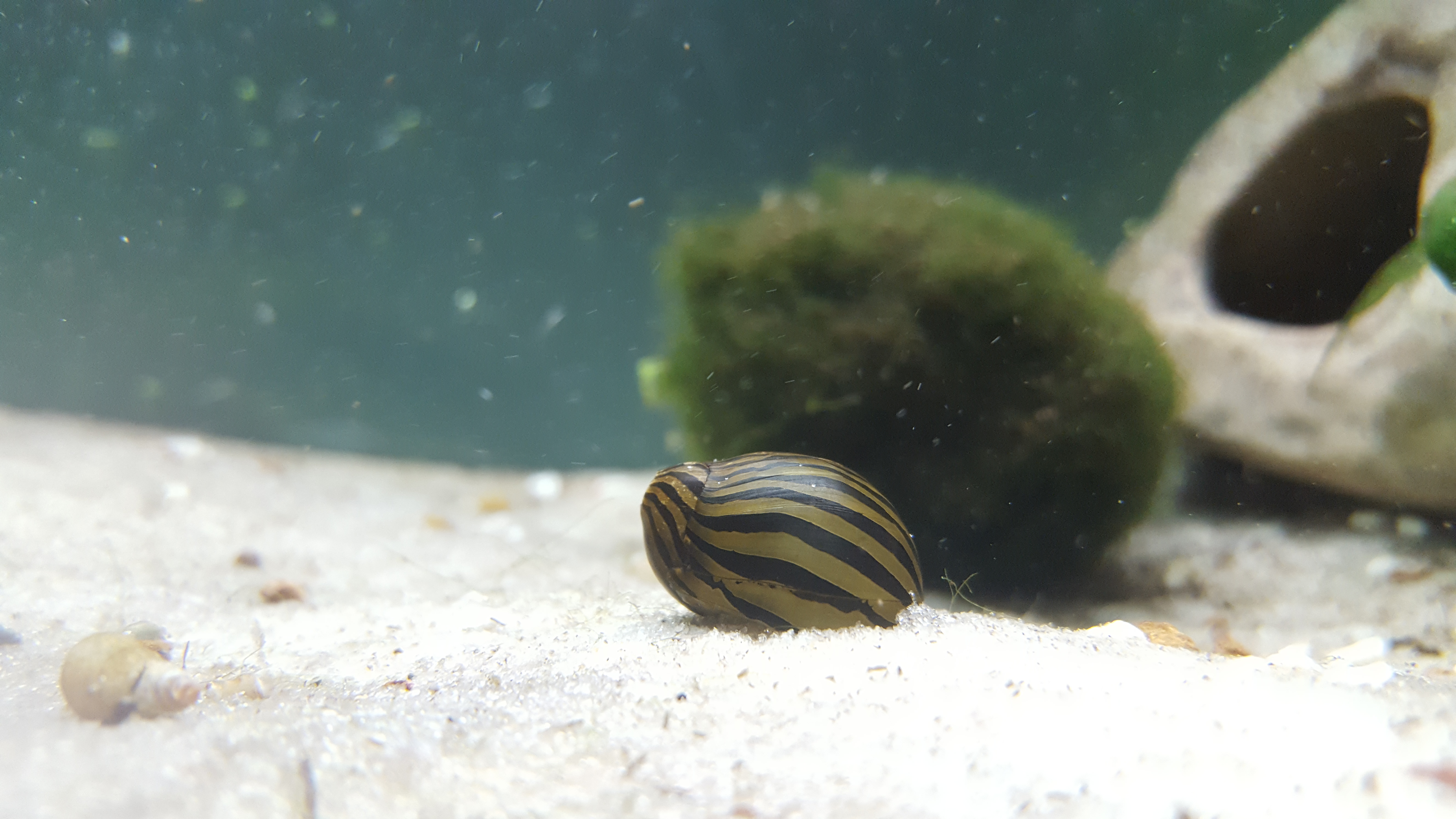
Quick Answer
Start with roughly one nerite snail per 5 gallons. A 10 gallon tank holds about two, a 20 gallon about four. That is the most common guideline, and sources treat it as a sensible ceiling for a tank with ordinary algae growth.
The catch is that nerites eat algae and biofilm, not fish food, so the number your tank supports is set by how much algae grows, not by water volume. A sunny tank with heavy algae might feed more snails than the rule suggests, while a spotless, heavily planted tank might starve even two. Add snails a few at a time, watch whether the algae clears, and adjust. Because nerites cannot breed in freshwater, the count never climbs on its own, so you decide it.
The Short Rule, and Why It Is Only a Starting Point
One nerite per 5 gallons is the figure you will see most often. Modest Fish's care guide states it plainly: follow one nerite per 5 gallons, so a 10 gallon tank should really only hold two. On the Aquarium Co-Op forum, a longtime keeper called that same ratio "the most densely you can stock them," while another said you could probably push it to one per 3 gallons in a tank with plenty of algae. So the usual working range runs from about one snail per 3 gallons at the dense end to one per 5 or more at the conservative end.
Sources do not all agree, and it is worth knowing where the outliers sit. Some blogs suggest five to ten nerites in a single 5 gallon tank, which is far above the one-per-5 guideline and, in the same breath, warns that too many snails in a small tank can create more waste than the nitrogen cycle can handle. When a single page recommends a number and then cautions against it, treat the number with suspicion. For a 5 gallon tank, one or two nerites is the honest answer, and a small group of three or four only makes sense if algae is genuinely out of control.
Nobody can hand you a single correct number because the rule is standing in for something it can't measure: how much food your tank produces.
Algae Is the Real Limiter, Not Water Volume
A nerite snail is a grazer. It spends its waking hours scraping the glass, rocks, driftwood, and leaves, eating the film of algae and the microscopic diatoms that coat every surface in an aquarium. It does not eat flake food the way a fish does, and that single fact is what makes stocking them different from stocking almost anything else.
In a well-established tank with healthy algae growth, nerites largely feed themselves, as Tankflare's care guide puts it. The flip side is that once they have mopped up every scrap, there is nothing left, and a tank that looked like it needed six snails last month might support only two now that the first wave did its job. One Aquarium Co-Op forum member found two nerites couldn't keep up with the algae in a slightly planted tank sitting in direct sunlight, and the advice that came back was to add four to six at a time and reassess every couple of weeks rather than guess at the start.
It also matters which algae you are fighting. Tankflare notes that nerites are excellent on green film algae, green dust algae, and the brown diatoms that bloom in a new tank, but they do not make a dent in black beard algae, hair algae, or green spot algae. If your problem is a beard of black fuzz on your plants, more nerites won't fix it, and you'll just end up with starving snails. For the fuzzy and stubborn kinds, our shrimp tank algae control guide covers what actually works.
So before you count gallons, look at your glass. A tank with a steady film of green and diatoms on the hardscape can feed snails; one you scrubbed clean yesterday cannot, however large it is.
Why Nerite Stocking Works Differently From Pest Snails
If you have ever watched a few bladder snails turn into a few hundred, you know why people fear adding snails at all. Nerites do not do this, and the reason is their life cycle. Nerites lay eggs readily in freshwater, but the larvae need brackish or saltwater to develop, so in a normal freshwater aquarium those eggs simply never hatch. Chewy's nerite care guide and Tankflare both describe the same thing: you will see small, hard, white egg capsules stuck to the glass and decor, but no baby snails will come of them.
This changes how you think about numbers in two ways. First, there is no population explosion to plan around. Whatever you put in is roughly what you keep, minus the occasional natural death over their one-to-two-year lifespan, so you set the count deliberately instead of bracing for a bloom. Second, the only downside of the eggs is cosmetic: some keepers barely notice the white specks, others scrape them off the hardscape during water changes.
It is the opposite of pest snails, where the tank decides the population and you are stuck managing it. With nerites, you decide, and that decision comes down to algae and bioload. For which snails suit a shrimp tank, see can shrimp live with snails.
Nerite Stocking by Tank Size
Here is the one-per-5-gallons rule turned into a table, with a second column for tanks that grow heavy algae and could support a few more. Treat the right-hand column as a ceiling you only reach if the algae justifies it, not a target.
| Tank size | Conservative (ordinary algae) | Heavy algae / sunny tank | Notes |
|---|---|---|---|
| 5 gallon | 1 | 1 to 2 | A 5 gallon is the sensible minimum for one small nerite |
| 10 gallon | 2 | 2 to 3 | The classic "two nerites" tank |
| 20 gallon | 3 to 4 | 4 to 5 | A small group grazes a large footprint |
| 29 gallon | 4 to 5 | 5 to 6 | Add gradually and watch the glass |
| 40 gallon | 6 to 8 | 8 | More surface area means more algae to clear |
| 55 gallon | 8 to 10 | 10 | Tankflare suggests 5 to 10 for a 55 gallon with an algae problem |
Chewy's guide backs the floor of this table, recommending at least 5 gallons for a single small nerite and more room for a group. The numbers climb roughly with surface area because surface area is where algae grows, and that is also why a long, shallow 40 gallon can feed more snails than a tall, narrow one of the same volume.
Snail Size Changes the Math
Not all nerites are the same size, and a bigger snail both eats more algae and produces more waste. Aquarium Co-Op describes the species sold in the hobby as ranging from about 0.5 to 1.5 inches, and the varieties sit at different points in that band.
| Variety | Rough adult size | Stocking effect |
|---|---|---|
| Zebra nerite | About 0.75 to 1 inch | The standard; the one-per-5 rule assumes roughly this size |
| Tiger nerite | About 1 to 1.25 inches | Similar to zebra, occasionally a touch larger |
| Horned nerite | About 0.25 to 0.5 inch | The smallest; you can keep a few more in the same space |
Sources disagree on the exact figures, and the same size claim turns up on different sites with different numbers, so take these as rough ranges rather than precise measurements. The practical point holds either way: a tank of tiny horned nerites can run a bit more densely than one stocked with full-size zebras, because each horned snail is a smaller mouth and a smaller waste source.
Bioload: Nerites Still Add Waste
It is easy to think of nerites as pure cleanup crew that only remove waste, but they are animals, and animals produce waste of their own. In a 40 or 55 gallon tank with a mature filter, a handful of snails is a rounding error on the bioload. In a 5 gallon nano, a pile of snails is not.
This is the real danger in overstocking a small tank. Pack six nerites into a 5 gallon and you have added a meaningful amount of ammonia-producing animal to a system with little buffer, and a lightly cycled nano can struggle to keep up. The one-per-5 rule exists partly to keep that bioload sane, not only to ration algae.
If your snails have cleared the algae and you want to keep them fed without overstocking, supplement rather than add more mouths. Nerites will take an algae wafer or a piece of blanched zucchini, though some keepers find that once the natural algae is gone, their snails lose interest in prepared food too. A sinking staple like Hikari Algae Wafers is a cheap thing to try, and it doubles as food for a shrimp colony.
Signs You Have Too Many, or Too Few
The tank will tell you whether your count is right long before any rule does. Watch for these.
Too many snails:
- •Snails climbing out of the water and sitting on the rim or the lid. A little of this is normal nerite behavior, since they are known escape artists, but snails constantly leaving the water are often looking for food that isn't in the tank.
- •Thin, pitted, or receding shells, which point to hungry snails or low minerals.
- •Snails dying off one by one a few weeks after you added a big group, a classic sign the tank couldn't feed them all.
- •Egg capsules covering every surface, which is more a cosmetic nuisance than a crisis but tends to scale with the number of adults.
Too few snails:
- •Algae keeps spreading faster than the snails clear it.
- •The glass greens up again within a day or two of cleaning.
If the algae is winning, add a couple more and wait two or three weeks before adding again, the gradual approach the Aquarium Co-Op keepers recommended. If snails are starving or escaping, you have too many for the food available, and the fix is to rehome some or start supplementing, not to scrub the tank cleaner.
Nerites in Small Tanks and Betta Tanks
Nano tanks are where stocking goes wrong most often, because the temptation is to add a cleanup crew the small volume can't support. In a 5 gallon, one nerite is plenty, and a tall, skinny 5 gallon with little algae may do better with none at all until the tank matures and grows some food.
Betta tanks raise the same question with a twist, since the betta and the snail have to get along as well as fit the bioload. A single nerite in a 5 gallon betta tank is a common and sensible pairing, and it is covered in full in our nerite snails with bettas guide. The stocking math is the same as any other tank: one small grazer, one small volume, and algae that has to be there to feed it.
Small tanks fill up fast. If you already keep a shrimp colony, count the snails as part of the total load, the way our how many shrimp per gallon guide treats the shrimp.
A Note on Copper
Copper is lethal to nerite snails, shrimp, and every other invertebrate in the tank, even at low doses. Never use a copper-based algae killer or snail treatment with inverts in the tank, check that any fish medication is invertebrate-safe first, and quarantine new plants that may have been treated. No amount of correct stocking survives a copper mistake.
Frequently Asked Questions
◆How many nerite snails for a 10 gallon tank?
About two, following the common one-per-5-gallons guideline. A 10 gallon with heavy algae or strong light might support a third, but add the extra snail only if the algae clearly needs it, and give the tank a couple of weeks between additions to see whether the first two keep up.
◆Can you have too many nerite snails?
Yes. Overstocked nerites run out of algae and then starve, climb out of the water, or die off a few weeks after you added them. In a small tank, too many snails also add enough waste to stress the nitrogen cycle. If snails are escaping or their shells look thin, you have more than the tank can feed.
◆How many nerite snails do I need to control algae?
Enough to match the algae your tank grows, which is why there is no fixed number. Start with one per 5 gallons, watch the glass for two or three weeks, and add a couple more only if algae is still spreading. Nerites don't touch black beard, hair, or green spot algae, so more snails won't solve those.
◆Will nerite snails overpopulate my tank?
No. Nerites lay eggs in freshwater, but the larvae need brackish or saltwater to develop, so the eggs never hatch in a normal aquarium. You will see small white egg capsules on the glass and decor, but no baby snails, which means the population stays exactly where you set it.
◆How many nerite snails can live with shrimp?
Count them as part of the tank's total bioload. A 10 gallon shrimp tank comfortably holds a nerite or two, and the animals don't compete much, since shrimp graze fine biofilm while the snail scrapes harder surfaces. Keep the combined load modest in a nano, and keep copper out entirely.
The Bottom Line
Start at one nerite per 5 gallons, then let the tank correct you. The rule is a reasonable opening bid, but algae growth is what actually feeds these snails, so a sunny tank might want a few more and a spotless one a few less. Add them gradually, watch for starving or escaping snails, and lean on the fact that nerites can't breed in freshwater: whatever you stock is what you keep, so there is no rush and no bloom to fear. When you are ready to pick varieties and dial in their water, our nerite snail care guide takes it from here.
Found this helpful?
Check out our other shrimp care guides