Blue Pearl Shrimp Care: The Other Blue Neocaridina
Blue pearl shrimp care guide: parameters, breeding, why they're a different species from blue dream and blue velvet, and the truth behind their color-fading reputation.
📅 Published 2026-09-22
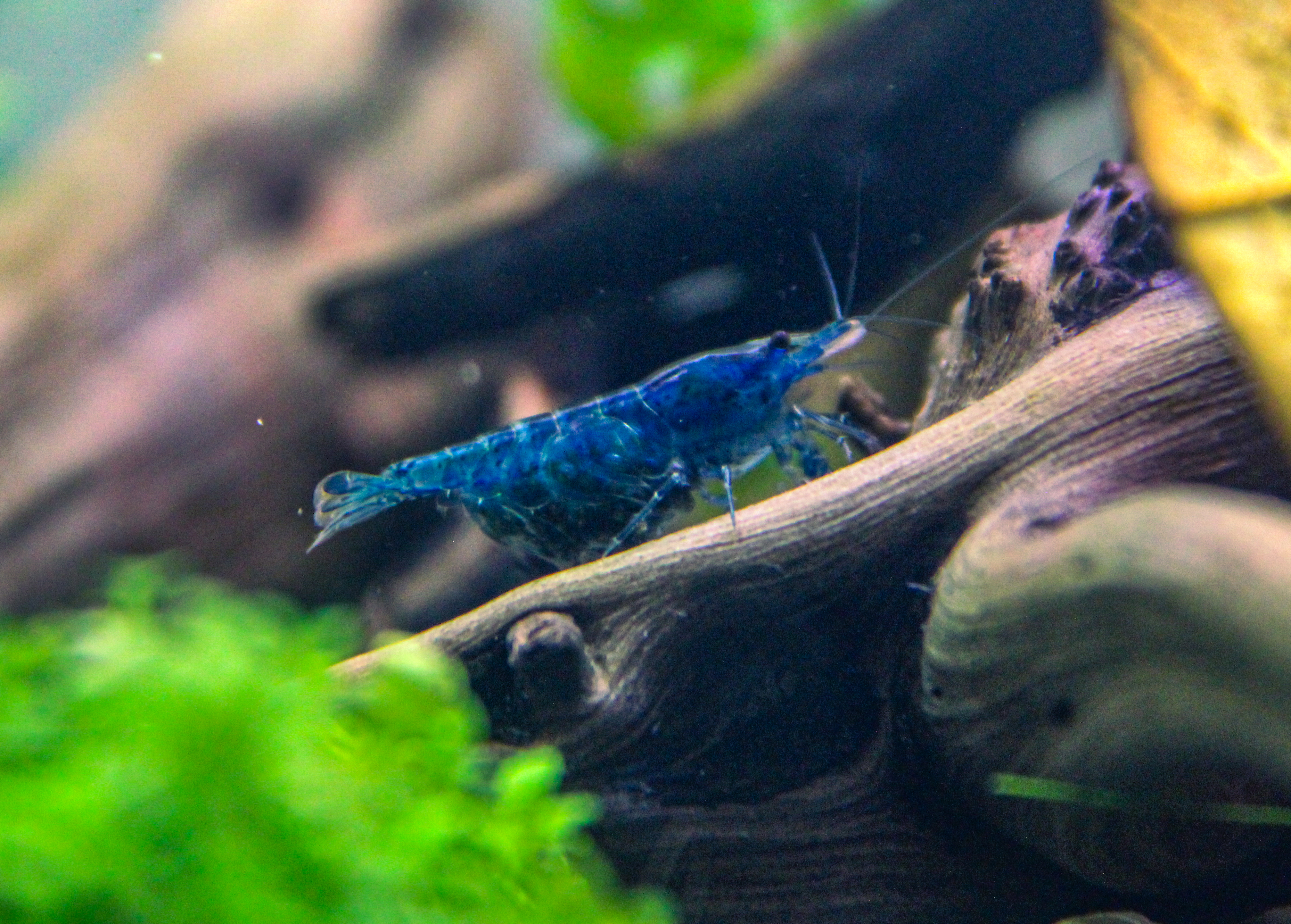
Blue pearl shrimp are the pale, icy blue Neocaridina that sit in the same shop tanks as blue dreams and blue velvets and get lumped in with them. They shouldn't be. Blue dreams and blue velvets are color forms of Neocaridina davidi, the cherry shrimp. Blue pearls came out of a separate wild shrimp from China, line-bred for blue in Germany around 2006, and nobody has managed to agree on which species they are.
Blue pearl shrimp care is cherry-shrimp easy. This guide covers what they actually are, how to tell them from the davidi blues, why so many keepers say theirs "washed out," and how to breed them without losing the color you paid for.
Quick Answer
Blue pearl shrimp are a selectively bred blue form of a Chinese Neocaridina sold as either Neocaridina cf. zhangjiajiensis or Neocaridina cf. palmata, depending on who you ask. Care is the same as for cherry shrimp: 68 to 78F, pH around 6.5 to 7.5, moderately hard water, a mature planted tank, and light feeding. They breed as fast as cherries. The two things that set them apart are the color, an icy light blue that varies a lot from shrimp to shrimp, and the fact that they'll interbreed with any Neocaridina davidi color, so keep them in their own tank.
Blue Pearl Shrimp Quick Facts
| Parameter | Range |
|---|---|
| Scientific name | Neocaridina cf. zhangjiajiensis var. blue (also sold as N. cf. palmata) |
| Origin | Selectively bred in Germany from Chinese wild stock, introduced 2006 |
| Adult size | 1 to 1.25 inches (2.5 to 3.2 cm), females larger |
| Lifespan | 1 to 2 years |
| Temperature | 68 to 78F (20 to 26C); tolerates roughly 64 to 82F |
| pH | 6.5 to 7.5 (sources range 6.2 to 8.0) |
| GH | 6 to 10 dGH (sources range 3 to 15) |
| KH | 1 to 8 dKH |
| TDS | 100 to 250 ppm (sources range 75 to 300) |
| Minimum tank | 5 gallons; 10 gallons better |
| Diet | Biofilm, algae, detritus, shrimp food |
| Breeding | Easy; eggs hatch into miniature adults |
| Temperament | Peaceful |
| Difficulty | Beginner |
Some of those ranges are wide because the sources disagree; the water parameters section explains where.
What a Blue Pearl Shrimp Actually Is
The blue pearl was introduced by German breeder Ulf Gottschalk in 2006, along with its white sibling, the snowball shrimp. Both were presented as color forms of Neocaridina zhangjiajiensis, a species Cai described in 1996 from Zhangjiajie in Hunan province, China. The "cf." that usually sits in the middle of the name means "compare with": the hobby was never certain the bred shrimp matched the described species, only that they were close.
Around 2013, the German taxonomy working group Crusta10 concluded that the snowball and blue pearl lines belong to Neocaridina palmata instead. That's the same revision that moved the cherry shrimp from Neocaridina heteropoda to Neocaridina davidi. The davidi change stuck. The palmata change only partly did. The Shrimp Farm notes it was never made official, Wikipedia still lists the blue pearl under N. zhangjiajiensis, and retailers split roughly down the middle. Jungle Aqua Shrimp and Aquarium Source sell them as palmata; River Park Aquatics and Guidarium as zhangjiajiensis.
For your tank, none of this matters; both candidate species are Chinese stream shrimp with the same needs. It matters when you're buying, because "blue pearl" and "Neocaridina davidi blue pearl" are two different shrimp.
Blue Pearl vs Blue Dream vs Blue Velvet
| Blue pearl | Blue velvet | Blue dream | |
|---|---|---|---|
| Species | N. cf. zhangjiajiensis / palmata | N. davidi | N. davidi |
| Shade | Icy, pale, semi-translucent blue | Light to medium translucent blue | Deep, opaque, solid blue |
| Eggs | Yellow to brown | Green to blue | Green to blue |
| Red patches | Sometimes, on parts of the body | Rili line can throw red | True lines shouldn't |
| Crossbreeds with cherries | Yes | Yes | Yes |
Blue velvet and blue dream are both Neocaridina davidi, bred from the same wild stock as the red cherry. The Shrimp Farm's grading guide lists the davidi blues as blue dream, blue fairy, blue jelly, blue rili and blue velvet, and even their breeders admit "there is no real clear agreement" on where one ends and the next begins.
Blue pearls don't do saturated. The Shrimp Farm describes them as "icy blue, sometimes with hints of red on parts of the body." Aquarium Source says the color is light blue "but there's plenty of variation," with some shrimp "almost pearl white or turquoise" and the darkest blue individuals the most valued. Next to a blue dream, a pearl looks like frosted glass beside paint.
The easiest field test is the eggs. Jungle Aqua Shrimp points out that blue pearl females carry yellow or brown eggs, while the davidi blues carry green or blue ones. Aquarium Domain likewise describes blue pearl eggs as yellowish. If your "blue pearl" female is berried with green eggs, you were sold a low-grade blue velvet.
One more wrinkle: the name gets borrowed. If a listing pairs "blue pearl" with Neocaridina davidi, it's a pale velvet under a trade name, not the Gottschalk line. Ask the seller for the species name before you buy, and if they say davidi, it's a velvet.
The Color-Fading Reputation
Search any shrimp forum for blue pearls and you'll find keepers whose shrimp were bluer at the store than at home, or whose babies came out clear. The reputation is partly deserved and partly a misunderstanding of what you bought.
They start pale. A blue pearl is a translucent shrimp with blue pigment in it, not an opaque one. Wikipedia's species page says color intensity "depends on genetics and water conditions" and that females color up more than males, and Aquarium Source agrees that the bluer individuals are usually female. A tank of blue pearls will always include near-white males and a few turquoise oddballs.
Light substrate washes them out. This one is real for every dwarf shrimp. ShrimpKeepers' color-loss guide describes fading on light or white substrate as camouflage, "a natural response, not illness," and The Shrimp Farm recommends black substrate specifically for blue pearls.
Stress and age. New arrivals fade for a couple of weeks after shipping, and old shrimp fade too. Both are on ShrimpKeepers' list.
Genetic drift. This is the one that quietly ruins colonies. ShrimpKeepers puts it plainly: "Without selective breeding (culling), colors dilute over generations." Blue pearls are a young line compared with cherries and the blue in them is not deeply fixed. If you never remove the clearest shrimp, the colony trends back toward the wild translucent form within a few generations.
Crossbreeding. If a cherry, yellow, or blue velvet has ever shared the tank, some of those pale babies are hybrids. See the section on mixing below.
What helps: dark substrate, stable water, foods with astaxanthin or spirulina (ShrimpKeepers suggests giving diet changes 4 to 8 weeks to show), and pulling the palest adults before they breed. What doesn't help: expecting a blue dream. If you want ink blue, buy one. If you want a piece of sea glass walking across your moss, a blue pearl is the right animal.
Water Parameters for Blue Pearl Shrimp
Blue pearls are as tough as cherries; Wikipedia, Practical Fishkeeping, and The Shrimp Farm all say so in different words. The published ranges are all over the place, though, so here's the spread.
Temperature. Practical Fishkeeping gives 64 to 82F with 70 to 79F as the sweet spot. Aquarium Source says 68 to 80F with 75 ideal. Wikipedia lists a survivable 59 to 86F and an optimum of 72 to 73F. Everyone agrees on the low 70s. Cooler water slows breeding and lengthens life; warmer speeds both up.
pH. The Shrimp Farm says 6.2 to 7.8, Aquarium Source 6.5 to 8.0 with 7.2 best, Guidarium and Practical Fishkeeping 6.5 to 8.0, River Park Aquatics 6.5 to 7.5. Neutral to slightly alkaline is safe; stability matters more than the number.
Hardness, where the sources split. The Shrimp Farm recommends a soft GH of 3 to 7 and a TDS of only 75 to 150. Guidarium says 6 to 15 dGH, B-Aqua 3 to 15 dGH with 6 to 10 for breeding, Jungle Aqua Shrimp 4 to 14 dGH and a TDS anywhere from 80 to 400, and Aquarium Source allows up to 20 dGH.
The practical read: blue pearls tolerate soft through hard water, and the middle, around 6 to 10 dGH and 100 to 250 TDS, sits inside every source's range and is where most tap water lands. Very soft water needs a mineral supplement; very hard water gets cut with RO. A GH and KH test kit and a TDS meter tell you where you are, and our shrimp water parameters guide explains what each number does to a molt.
Copper. Zero. Check fertilizers and medications before they go in.
Tank Setup
Size. The Shrimp Farm and Practical Fishkeeping are happy with 5 gallons or even smaller; Aquarium Source and Aquarium Domain want 10. Ten is easier to keep stable. Start with at least 6; B-Aqua recommends 12 for a breeding group.
Substrate. Dark and inert. Black sand or dark gravel makes the blue read as blue instead of grey, and Caridina buffering soils pull pH and KH lower than blue pearls need.
Filter. Sponge filter. It can't eat shrimplets and it grows biofilm, which is most of what the colony eats.
Plants. Moss, a few stems, some leaf litter. Guidarium describes blue pearls as active grazers that do best over established algae and leaf litter.
Lid. Guidarium calls them hyperactive fast swimmers, and males spend a lot of time zipping around after freshly molted females. A lid keeps evaporation and the occasional explorer in.
Feeding
Blue pearls are detritus feeders. They spend the day picking biofilm, algae, and decaying plant matter off every surface, and in a mature planted tank that's most of their diet. Supplement lightly: a staple like Hikari Shrimp Cuisine two or three times a week, a blanched vegetable now and then, and pull anything still there after a couple of hours. The Shrimp Farm suggests daily feeding; a mature tank usually needs less. For color, a food with astaxanthin or spirulina helps over a month or two. It won't turn a pale line dark, but it stops a good line from looking hungry.
Breeding Blue Pearl Shrimp
If the water is stable and both sexes are present, they'll breed without being asked; Practical Fishkeeping says no special steps are needed for any Neocaridina.
A female shows a yellowish saddle behind the head when eggs are developing, then carries 20 to 30 yellow to brown eggs under her tail. Aquarium Source puts the clutch at about 30; B-Aqua says around 20, up to 30. Sources disagree on how long she carries them. B-Aqua gives 20 to 25 days at 68 to 72F, The Shrimp Farm and Aquarium Domain say about a month, and Wikipedia stretches it to 30 to 45 days. Warmer water is faster; expect three to five weeks.
The eggs hatch into fully formed miniature shrimp, no larval stage, no brackish water. They graze biofilm from day one, so moss and leaf litter matter more than fry food. Maturity arrives at 2 to 3 months by Aquarium Domain's count, 3 to 4 by B-Aqua's, and females then berry every two to three months.
What separates a good blue pearl colony from a grey one is selection. Pull the palest adults before they breed and keep the darkest females, the same routine cherry breeders use.
Keep Them Away From Other Neocaridina
People break this rule by accident, because "different species" sounds like "safe to mix." It isn't. The Shrimp Farm states that blue pearls can interbreed with Neocaridina davidi varieties and calls the result undesirable; Jungle Aqua Shrimp says they "will interbreed readily" with the cherry shrimp group. Whether the two are separate species or not, they're close enough to cross, and the offspring trend toward the brownish wild type just like a cherry-yellow cross does.
The same applies to snowballs, which are the same line in white; a mixed tank is one colony and produces pale, patchy babies.
What you can keep them with:
- •Any Caridina: crystal reds, bee shrimp, tigers, amanos. Different genus, no crossing. Just make sure the water suits both.
- •Snails: nerites, mystery snails, ramshorns.
- •Dwarf crayfish, which The Shrimp Farm lists as compatible. We'd still expect a few shrimplets to go missing.
What you can't, if you want to keep the color: any other Neocaridina, in any color. Our mixing shrimp colors guide covers the genetics of why.
Frequently Asked Questions
◆Are blue pearl shrimp the same as blue velvet shrimp?
No. Blue velvets are Neocaridina davidi, the cherry shrimp species. Blue pearls are a separate line bred from a different Chinese Neocaridina, listed as N. cf. zhangjiajiensis or N. cf. palmata. Blue pearls are paler and more translucent, and their females carry yellow to brown eggs rather than green ones. Care is the same for both.
◆Why did my blue pearl shrimp lose their color?
Usually one of four things: pale substrate, stress from a move or a water swing, age, or genetic drift because the palest shrimp were allowed to breed. A fifth cause is crossbreeding with another Neocaridina. Dark substrate, stable water, and removing the clearest adults before they breed fix most of it.
◆Can blue pearl shrimp live with cherry shrimp?
They can share a tank without fighting, but they'll interbreed, and the offspring drift toward brown wild-type. Keep blue pearls in their own tank or with Caridina species like crystal reds or amanos, which can't cross with them.
◆What water parameters do blue pearl shrimp need?
Aim for 68 to 78F, pH 6.5 to 7.5, GH 6 to 10, and TDS 100 to 250. Published ranges are wider than that in every direction, so blue pearls will tolerate softer or harder water, but the middle is where every source overlaps and where they breed most reliably.
◆How big do blue pearl shrimp get?
About an inch, with females reaching 1.25 inches (3 cm) and males staying a bit smaller. Wikipedia gives 2.5 to 3.2 cm for adults; B-Aqua lists males at 2 to 2.5 cm and females at 2.5 to 3 cm.
The Bottom Line
Blue pearl shrimp are a cherry shrimp in everything but name and color: same water, same food, same breeding rate. What you're buying is a pale, glassy blue on a shrimp whose species name the hobby still argues about. Give them dark substrate, keep the water steady, cull the clear ones, and never let a davidi into the tank. If you'd rather have a deep opaque blue with no color-management homework, our blue dream shrimp care guide is the one to read instead.
Found this helpful?
Check out our other shrimp care guides