Blue Tiger Shrimp Care (Orange Eye Blue Tiger): Parameters, Genetics, Breeding
Blue tiger shrimp care for the orange eye blue tiger (OEBT): the water they actually want, why the eyes are orange, how they differ from blue bolts, and grading.
📅 Published 2026-09-23
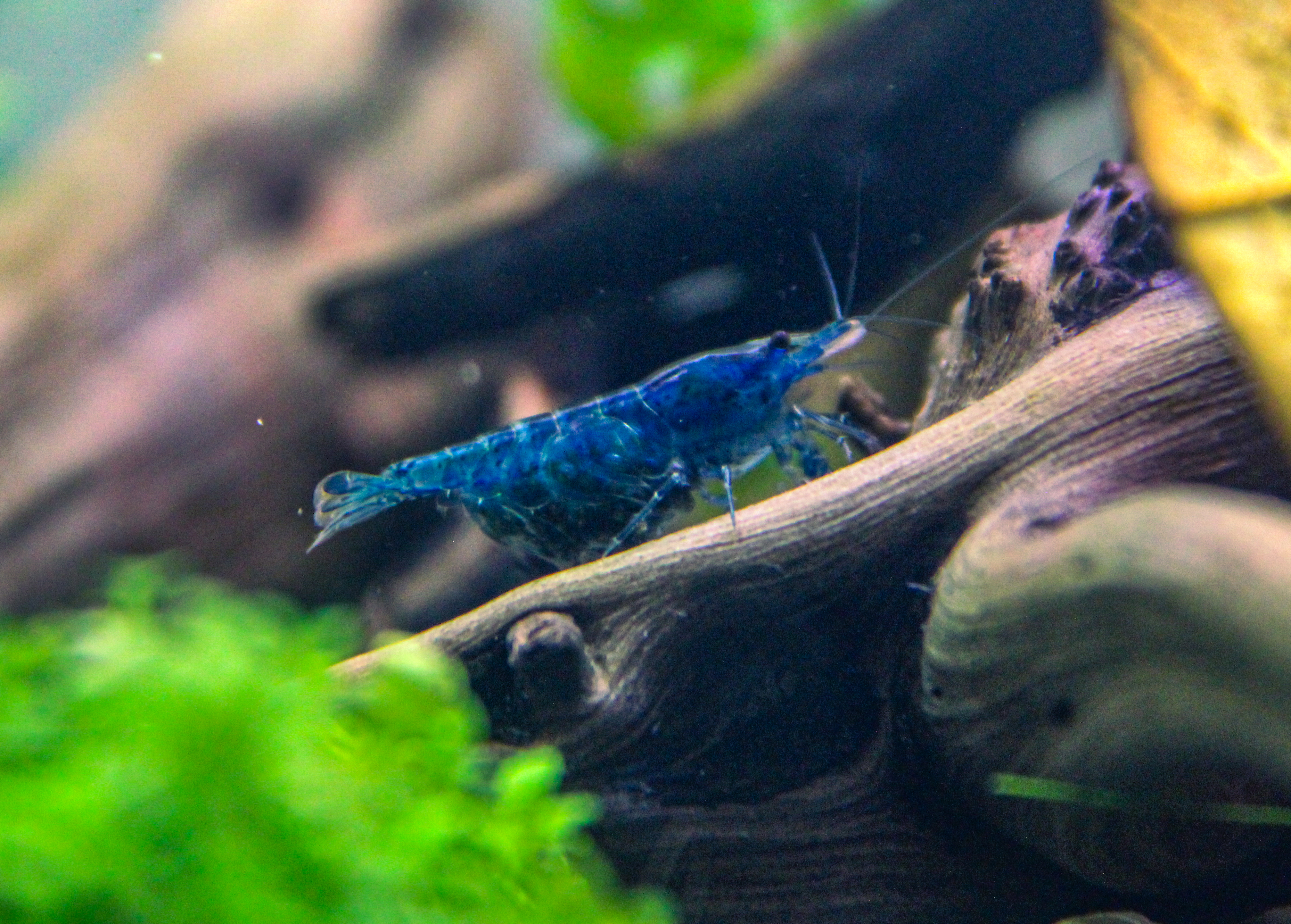
Blue tiger shrimp care is easier than the price tag suggests and harder than the "tigers are the easy Caridina" line you'll hear at the store. The orange eye blue tiger, usually shortened to OEBT, is a tank-bred Caridina with a deep blue body, black tiger stripes, and eyes that glow orange under the light. It's one of the few Caridina that doesn't demand the near-zero KH that bee shrimp do, which is why so many people pick it as their first step past cherry shrimp.
The catch is that OEBT come from a narrow, heavily line-bred gene pool, and they show it. They're more sensitive to sloppy water than a plain wild-type tiger, they don't breed true for the blue, and the numbers on care sheets disagree more than for any other common shrimp. This guide sorts that out: what the water needs to be, why the eyes are orange, how OEBT differ from blue bolts, and what to expect when they breed.
Quick Answer
Orange eye blue tigers are a color line of Caridina mariae, the tiger shrimp, bred for solid blue bodies and orange eyes. Keep them in a mature, cycled tank of 10 gallons or more, in remineralized RO water at roughly 68 to 75F, pH somewhere between 6.2 and 7.5, GH 4 to 6, KH 0 to 4, and TDS in the 120 to 200 range. Stability matters more than any single number. They breed like other dwarf shrimp, with eggs hatching in about 30 days, but the blue doesn't pass to every baby, so expect to cull and select. Our tiger shrimp care guide covers tigers in general; this one goes deep on the blue orange eye line specifically.
Blue Tiger Shrimp Quick Facts
| Parameter | Range |
|---|---|
| Scientific name | Caridina mariae "Blue Tiger" (older tags: Caridina cf. cantonensis) |
| Common names | Blue tiger, orange eye blue tiger, OEBT, royal blue tiger (darkest grade) |
| Origin of the wild species | Guangdong province, southern China, and Hong Kong |
| Origin of the OEBT line | Selective breeding only; the orange eye blue form doesn't occur wild |
| Adult size | 1 to 1.2 inches (2.5 to 3 cm) |
| Temperature | 65 to 77F (18 to 25C); 68 to 74F is the overlap most sources agree on |
| pH | 6.2 to 7.5 (sources disagree, see below) |
| GH | 4 to 6 dGH (a few sheets allow up to 10) |
| KH | 0 to 4 dKH (some sheets allow higher) |
| TDS | 120 to 200 ppm (published ranges run from 120 to 250) |
| Minimum tank | 5 gallons workable, 10 gallons recommended |
| Egg incubation | About 30 days |
| Lifespan | 1 to 2 years |
| Temperament | Peaceful |
| Difficulty | Intermediate |
What an OEBT Actually Is
Tiger shrimp spent years in the hobby as Caridina cf. cantonensis "Tiger," lumped in with the bee shrimp. In 2014 Werner Klotz and Thomas von Rintelen described them as a separate species, Caridina mariae, and later molecular work placed C. mariae as the sister species to C. cantonensis. So a tiger and a crystal red are close cousins rather than the same animal, which explains both why they can hybridize and why their water preferences differ.
Wild C. mariae is a semitransparent shrimp with dark brown to black stripes down the back half of the body. The blue came from breeders picking the bluest individuals out of their tiger colonies and pairing them, generation after generation, according to The Shrimp Farm's grading write-up. The orange eye is a separate trait that turned up along the way and was fixed into the line. Both Buce Plant and Blackwater Aquariums describe the OEBT as a morph "achieved by extensive selective breeding," and no source we found reports the blue orange-eyed form in the wild.
That history is the key to everything else in this guide. A shrimp built by narrowing the gene pool for two cosmetic traits carries the costs of a narrow gene pool.
Why the Eyes Are Orange
Orange eyes show up in several Caridina and Neocaridina lines, and they behave the same way wherever they appear. Errly Aquatics, writing about their orange eye Neocaridina lines, says the trait "behaves like a recessive trait": a shrimp usually has to inherit the gene from both parents to show orange eyes, and a shrimp with one copy looks normal but passes it on. The Shrimp Farm's OEBT care sheet fits that picture from the other direction: in their experience the orange eyes breed true, so even offspring that miss out on the blue still get the orange eyes. That's exactly what you'd expect from a line where every shrimp carries two copies.
What the gene does is reduce the dark pigment in the eye, which is why the eye reads as orange rather than black. Shrimp Science goes a step further and suggests the cause is a shortage of rhodopsin, the light-sensitive pigment in the eye, and that OEBT may see poorly as a result. We only found that claim in one place, so treat it as a plausible explanation rather than settled fact. In the tank, OEBT graze, find food, and flee shadows like any other shrimp.
Eye color also varies within the line. The Shrimp Farm notes eyes can come out golden or silver, and lower-grade shrimp are often sold with brownish eyes. Bright, clearly orange eyes are one of the marks of a high-grade animal.
Blue Tiger vs Blue Bolt: Not the Same Shrimp
These two get confused constantly because both are blue Caridina at a similar price. They're different species from different breeding lines, and they want different water.
| Orange eye blue tiger | Blue bolt | |
|---|---|---|
| Species | Caridina mariae (tiger line) | Caridina cantonensis (Taiwan bee line) |
| Pattern | Solid blue with dark vertical stripes; top grades lose the stripes | White head fading into a blue tail, no stripes |
| Eyes | Orange (golden or silver in some) | Black |
| KH tolerance | 0 to 4, some keepers run higher | 0 to 1, strict |
| pH | 6.2 to 7.5 depending on source | 5.8 to 6.8 |
| Difficulty | Intermediate | Advanced |
The practical difference is water. Blue bolts and the rest of the Taiwan bee family need soft, acidic, mineral-poor water with KH held near zero. Tigers come from the same region but tolerate a wider band, and several retailers sell OEBT specifically as tigers that do fine at the upper end of the Caridina range. If you've read our blue bolt shrimp care guide and decided those parameters look like a full-time job, OEBT are the easier blue.
One warning: the two lines can interbreed. Shrimp Science notes tigers are popular for hybridizing, and The Shrimp Farm describes the "blue steel" shrimp as a cross between a blue bolt and a tangerine tiger. Tiger-bee hybrids can be gorgeous, but if you want your OEBT to stay OEBT, don't house them with any bee shrimp.
Water Parameters: Why the Care Sheets Disagree
We pulled parameters from five sources for this article and they don't line up. Here's the spread:
| Source | Temp | pH | GH | KH | TDS |
|---|---|---|---|---|---|
| The Shrimp Farm | 65 to 75F | 6.0 to 7.5 | 4 to 10 | 2 to 6 | 150 to 250 |
| Shrimp Science | 68 to 77F | 7.0 to 7.5 | 4 to 10 | 1 to 8 | 130 to 250 |
| Buce Plant | 68 to 74F | 6.2 to 6.6 | 4 to 5 | 0 to 1 | 120 to 140 |
| Blackwater Aquariums | 64 to 75F | 5.0 to 7.5 | 4 to 6 | 0 to 4 | 150 to 250 |
| Wikipedia (C. mariae) | 65 to 75F | 6.0 to 7.5 | not given | not given | not given |
Buce Plant's numbers are bee shrimp numbers. Shrimp Science's are close to Neocaridina numbers. Both retailers sell healthy OEBT, which tells you the real answer: this shrimp tolerates a wide range as long as it lands somewhere in it and stays there. The tighter the water is held, the better the blue and the better the breeding.
Our recommendation for someone setting up their first OEBT tank is the middle of the overlap:
- •Temperature: 68 to 74F. Cooler is fine; above the mid 70s, oxygen drops and lifespan shortens.
- •pH: 6.5 to 7.2. If your tank runs a buffering substrate you'll land near the bottom of that; on inert substrate you'll be near the top. Either works.
- •GH: 4 to 6 dGH. Enough calcium and magnesium to molt cleanly.
- •KH: 0 to 3 dKH. Tigers don't need the zero KH that bees do, but low KH keeps pH from drifting upward.
- •TDS: 130 to 180 ppm.
Start with RO or RO/DI water and add minerals back. A Caridina mineral such as SaltyShrimp Bee Shrimp GH+ raises GH without adding KH, which is what you want if you're running a buffering soil. If your tank is on inert substrate and you'd like a little KH for pH stability, a GH/KH+ product made for Neocaridina works too. Our best remineralizer for shrimp guide walks through the choices, and tap water vs RO water explains why the store's advice to "just use tap" is a gamble with a $10 shrimp.
Whatever numbers you pick, measure them. A TDS meter tells you in five seconds whether the water you mixed matches the water in the tank, and matching is the whole job.
Tank-Raised, Inbred, and What That Means for You
Every OEBT you'll ever buy is tank-raised. There's no wild population to collect from, and the line has been selected for color across many generations. Both The Shrimp Farm and Aquarium Breeder make the same point in nearly the same words: blue tigers are "a little fragile due to inbreeding" and more prone to disease than a plain tiger.
In practice this shows up three ways.
They're less forgiving of a swing. A wild-type tiger shrugs off a 10 percent TDS jump after a water change. An OEBT from a tight line may fail a molt over the same change. Do smaller water changes, 10 to 15 percent weekly, matched for temperature and TDS.
They're more sensitive to nitrate and dirt. Aquarium Breeder singles out nitrate and general pollution as things blue tigers don't tolerate. Keep nitrate under 20 ppm, don't overfeed, and don't stir the substrate.
Lineage matters when you buy. A breeder who outcrosses to wild-type or black tigers to keep vigor sells hardier shrimp than one who has chased the darkest blue for ten generations. Ask. If a new batch arrives with translucent, patchy blue, that's a low grade, not a sick shrimp, and it may be the more resilient purchase.
Tank Setup
OEBT want what all Caridina want: an old tank. A 10 gallon is the sensible minimum for the extra water stability, though experienced keepers run them in 5s. Cycle it fully, then let it sit a few more weeks growing biofilm before the shrimp arrive.
- •Substrate: an active buffering soil such as Fluval Stratum holds pH in the mid 6s. Inert sand works if you're happy running pH around 7 with a touch of KH. Dark substrate makes the blue look deeper.
- •Filtration: a sponge filter. It grows food, can't eat shrimplets, and doesn't blast the water around.
- •Plants and wood: mosses, driftwood, and a few Indian almond leaves. The tannins give a slight stain that keepers report deepens the blue.
- •Light: moderate. Very bright tanks wash out the color and make the shrimp hide.
Skip fish if you want the colony to grow. The Shrimp Farm's advice is blunt: if you're breeding, "skip the fish altogether." Snails are fine.
Feeding
OEBT are grazers. In a mature tank most of their diet is biofilm and the algae on every surface, and supplemental food is a top-up two or three times a week. Shrimp Science lists algae wafers, shrimp pellets, bee pollen, and blanched vegetables as the standard rotation. A quality shrimp food like Shrimp King Complete covers the bases. Feed what disappears in an hour or two and pull the rest, because uneaten food is the nitrate source these shrimp tolerate least.
Breeding and Grading OEBT
The good news first: OEBT breed the same way cherry shrimp do. A female develops a saddle of eggs behind the head, molts, releases a pheromone that sends every male in the tank swimming laps, mates, and then carries the fertilized eggs under her tail for about 30 days. The babies hatch as tiny copies of the adults, no larval stage, and graze biofilm from day one. Give them moss and leaf litter for cover and they'll raise themselves.
The complicated news is what comes out. The blue does not breed true. The Shrimp Farm says outright that the blue coloration "isn't always passed to all offspring," and Buce Plant warns that the line "produces offspring of varying color grades, making culling and selection essential." A batch from two dark blue parents will include some dark blues, some pale or patchy blues, and some shrimp with almost no blue at all, and all of them will have orange eyes.
Grading follows The Shrimp Farm's chart:
- •High grade: fully opaque blue including the legs, with clear stripes and bright orange eyes. The darkest of these, so dark the stripes vanish, are sold as royal blue tigers and count as high grade too.
- •Medium grade: solid blue body but transparent legs and sometimes a see-through underbelly.
- •Low grade: splotchy, translucent blue, often with brownish eyes.
Two things to know before you start culling. Females are always more deeply colored than males, so don't remove every pale shrimp or you'll be left with an all-female tank. And rusty or brownish patches can show up at any grade; they're not a defect that runs in a line.
To improve a colony, keep the darkest, most opaque animals of both sexes, move the palest to a second tank or sell them as low grade, and repeat for a few generations. It's slow. It's also how every high-grade OEBT you've ever seen was made.
Frequently Asked Questions
◆Are orange eye blue tiger shrimp hard to keep?
Intermediate. They're easier than blue bolts and other Taiwan bees because they tolerate a wider pH and KH range, but they're more fragile than cherry shrimp and wild-type tigers because of generations of inbreeding for color. A mature tank, remineralized RO water, and small matched water changes cover most of the risk.
◆Can blue tiger shrimp live with cherry shrimp?
Yes. Tigers are Caridina and cherries are Neocaridina, so they can't interbreed, and they get along fine. The problem is water: cherries like harder, more alkaline water than most OEBT sheets recommend. A tank run at pH 7.0 to 7.2, GH 6, and KH 2 to 3 sits in the overlap and keeps both alive, but neither will be at its best.
◆Why do orange eye blue tiger babies have no blue?
Because the blue is a selected trait that doesn't pass to every offspring, while the orange eye is fixed in the line and does. Every batch includes pale and clear shrimp. Keep the darkest for breeding and sell or separate the rest, and the proportion of blue improves over generations.
◆What is the difference between a blue tiger and a blue bolt?
Different species. Blue tigers are Caridina mariae with stripes and orange eyes and tolerate KH up to a few degrees. Blue bolts are Taiwan bee Caridina cantonensis with a white-to-blue gradient, black eyes, and a strict need for KH near zero. Blue tigers are the easier of the two.
◆Do OEBT need RO water?
Nearly always. A few keepers with naturally soft tap water get away without it, but most tap water carries too much KH and too many unknowns for a shrimp this sensitive. RO water plus a shrimp remineralizer gives you repeatable numbers, and repeatability is what keeps OEBT alive.
The Bottom Line
Orange eye blue tigers are the friendliest route into blue Caridina, provided you respect what they are: a heavily line-bred shrimp that wants old, clean, stable water more than it wants any particular number on a chart. Set up a mature 10 gallon on remineralized RO, aim for the middle of the published ranges, change water in small matched batches, and buy from someone who can tell you how the line has been kept. Then enjoy the part nobody warns you about, which is that the culls are still orange-eyed tiger shrimp and look great in a second tank. For the rest of the family, start with our tiger shrimp care guide linked above and the Caridina vs Neocaridina breakdown.
Found this helpful?
Check out our other shrimp care guides