Can Shrimp Live With Rasboras? Chili, Harlequin, Lambchop and Phoenix Compared
Can shrimp live with rasboras? Adults, yes. Which of the four common rasboras are safest for shrimplets, the water chemistry catch, planting density, and numbers.
📅 Published 2026-10-02
Rasboras are the fish most people reach for when they want movement above a shrimp colony without turning the colony into fish food. That instinct is mostly right. The four you'll actually find in a shop, chili, harlequin, lambchop and phoenix, are small, peaceful, midwater fish with mouths that can't fit an adult cherry shrimp. If you're asking can shrimp live with rasboras, the adults are not the question.
The questions are what happens to the babies, whether the fish and the shrimp want the same water, and how many of each fit in your tank. This guide takes the four species one at a time, gives the numbers from the species databases and the retailers, and says where they disagree.
Quick Answer
Yes, shrimp can live with rasboras. All four common species leave adult dwarf shrimp alone, and Seriously Fish lists both Boraras species (chili and phoenix) as suitable to house with Caridina and Neocaridina. Every source that mentions babies says the same thing in different words: any rasbora will eat a newborn shrimplet it finds. The smaller the fish, the fewer it catches.
Ranked by safety for a breeding colony: phoenix and chili first (under an inch, tiny mouths, stay off the bottom), lambchop second (about 1.2 to 1.5 inches), harlequin last (up to 2 inches, big enough to take juveniles a couple of weeks old). In a planted tank with moss, colonies keep growing under all four. In a bare tank, expect the population to stall.
Why Rasboras Suit a Shrimp Tank
A fish is dangerous to shrimp when it has a mouth big enough to swallow one, hunts along the bottom, or has a temper. Rasboras score low on all three.
They're micropredators. Seriously Fish describes all four as fish that pick tiny insects, worms and crustaceans out of the water in the wild, and a cherry shrimp is far too big to count. Aquarium Co-Op puts it plainly: fish this size "won't bother the adult-sized dwarf shrimp."
They live in the middle of the tank. Aquarium Co-Op says chili rasboras "prefer to feed from the middle of the water column," and AquariumStoreDepot describes lambchops as occupying "the middle third." Shrimp live on the substrate, the moss and the glass.
They're timid rather than bossy. Seriously Fish calls the Boraras species "very peaceful" and too shy for a rough community tank. A fish that spooks at shadows isn't going to harass a shrimp.
Will Rasboras Eat Baby Shrimp?
Yes. A newly hatched cherry shrimp is roughly 2 mm long (Shrimp and Snail Breeder measured hatchlings at 2.3 mm on average), a fair match for the zooplankton these fish eat in the wild. The Shrimp Farm's chili guide says baby shrimp "may get eaten as they are natural food for chili rasboras at the small size," and its phoenix guide says the fish "will eat newly hatched fry if they get the chance." Aquarium Co-Op's line covers the whole family: "all fish will try to opportunistically snack on baby shrimp."
What the sources don't agree on is how much it matters. The Shrimp Farm expects cherry and crystal red colonies to do fine alongside phoenix rasboras, "especially if you add some Java moss for the babies to hide in." AquariumStoreDepot's lambchop guide says shrimplets "may be snacked on" and tells breeders to provide dense cover. A keeper on the Fishlore forum who ran harlequins with cherries never saw the fish go after them but assumed the babies were on the menu whenever nobody was watching. I'd read that as one answer: losses are real, they're small, and cover decides how small.
Mouth size sets the ceiling. A 0.8 inch phoenix rasbora can only take a shrimplet in its first few days; a 2 inch harlequin can take one a couple of weeks old. Feeding sets the rate: a fish that gets a pinch of micro pellets every day spends less time inspecting the moss. For how a "fine with adults, eats babies" fish affects colony growth over months, our can shrimp live with tetras guide works through the math, and it applies here unchanged.
The Four Common Rasboras
Sizes are maximum standard length from Seriously Fish, cross-checked against Aquarium Co-Op, Wikipedia and retailer care sheets. Where sources differ, both figures are given.
◆Chili Rasbora (Boraras brigittae)
Also sold as the mosquito rasbora. Seriously Fish gives a maximum of 20 mm (0.8 inch); Aquarium Co-Op says about 3/4 inch; The Shrimp Farm says about 1 inch. This is the rasbora Aquarium Co-Op names in its own cherry shrimp guide as a compatible tank mate.
Temperature lines up across sources: 68 to 82F (Seriously Fish), 72 to 82F (Aquarium Co-Op), 72 to 79F (The Shrimp Farm), all overlapping the Neocaridina comfort zone of 72 to 76F. Group size: 8 to 12 (Aquarium Co-Op), 8 to 10 (Seriously Fish), 10 or more (Flip Aquatics). Aquarium Co-Op has kept them in planted tanks "as small as 3 gallons," but for a school plus a colony, 10 gallons is the floor.
◆Phoenix Rasbora (Boraras merah)
The chili's near twin, with dark blotches instead of a solid stripe. Seriously Fish gives the same 20 mm maximum; The Shrimp Farm says "a little under an inch"; Aquatic Arts lists 0.6 to 0.8 inch. Same size, same midwater habits, same verdict: Seriously Fish lists it as compatible with Caridina and Neocaridina, and Aquatic Arts says it "can be safely kept with dwarf shrimp."
Temperature is 68 to 82F across Seriously Fish, The Shrimp Farm and Aquatic Arts. Group size ranges from 6 (Aquatic Arts) through 8 to 10 (Seriously Fish) to 10 plus, ideally 20 (The Shrimp Farm). Bigger schools are calmer and redder. Aim for 10.
◆Lambchop Rasbora (Trigonostigma espei)
Named for the lamb chop shape on its flank and often confused with the harlequin. It's the smaller of the two: 30 mm (1.2 inch) on Seriously Fish, "up to 1.5 inches" on AquariumStoreDepot and Shrimpy Business. That extra size shows up in the shrimplet math. AquariumStoreDepot is direct: adult cherry and amano shrimp "are generally safe," but shrimplets "may be snacked on, since they're small enough to fit in the rasboras' mouths."
Lambchops want warmer water than the Boraras. Seriously Fish and AquariumStoreDepot give 73 to 82F, Shrimpy Business 74 to 82F. That's the top half of the Neocaridina range and above where most Caridina keepers run. Keep 6 minimum, 8 to 12 better; both retailers recommend a 20 long.
◆Harlequin Rasbora (Trigonostigma heteromorpha)
The classic, and the biggest of the four. Seriously Fish gives 45 mm (1.8 inch); Wikipedia says 4 to 4.5 cm with a maximum near 5.1 cm; Aquarium Co-Op and AquariumStoreDepot say about 2 inches. Both Wikipedia and AquariumStoreDepot give it a 5 to 8 year lifespan, so it's a long commitment.
Two inches is nowhere near enough to eat an adult Neocaridina, and Aquarium Co-Op's advice for harlequins matches the rest of the family: they snack on babies opportunistically and leave adults alone. But a harlequin's mouth keeps shrimplets on the menu for a couple of weeks after hatching rather than a couple of days. Of the four, this is the one where a breeding colony most needs cover and a head start.
Water is easy: 70 to 82F (Seriously Fish, Wikipedia), 72 to 82F (Aquarium Co-Op), with pH and hardness ranges that put cherry shrimp water in the middle. Keep 8 or more; AquariumStoreDepot warns that in groups of 6 or fewer "the schooling breaks down and fish become shy and reclusive." A 20 long is the right home.
Rasbora and Shrimp Compatibility Table
| Rasbora | Max size | Temp (sources agree) | pH (across sources) | Neocaridina (65 to 78F) | Caridina (68 to 74F) | Shrimplet risk |
|---|---|---|---|---|---|---|
| Phoenix (B. merah) | 0.8 in / 2 cm | 70 to 79F | 4.0 to 7.5 | Good | Good | Low |
| Chili (B. brigittae) | 0.8 in / 2 cm | 72 to 79F | 4.0 to 8.0 | Good | Good | Low |
| Lambchop (T. espei) | 1.2 to 1.5 in | 74 to 82F | 5.5 to 7.5 | Good at 74F and up | Marginal, top of range | Moderate |
| Harlequin (T. heteromorpha) | 1.8 to 2 in | 72 to 80F | 6.0 to 7.5 | Good | Good at 72 to 74F | Moderate to high |
"Shrimplet risk" means how long after hatching a shrimplet stays small enough to swallow, not how often the fish tries. That comes down to cover and feeding.
The Water Chemistry Catch
Here's the part most tank mate lists skip. Chili and phoenix rasboras come from the blackwater peat swamps of Borneo, and the species databases describe water that would wreck a cherry shrimp colony over time. Seriously Fish gives chilis a pH of 4.0 to 7.0 at 1 to 10 dGH, and phoenix rasboras 4.0 to 6.5 at 1 to 5 dGH. Aquarium Co-Op's cherry shrimp guide wants a GH of at least 6 and a KH of at least 2, with pH anywhere from 6.5 to 8.5. Our shrimp water parameters guide gives the same picture.
The retailers tell a different story. Aquarium Co-Op runs chilis at pH 6.0 to 8.0, The Shrimp Farm at 6.0 to 7.5, and Flip Aquatics keeps both Boraras at pH 7.2 to 7.5 and GH 8 to 16, which is a cherry shrimp tank with fish in it. Both camps are right. Seriously Fish describes the wild habitat; the retailers describe tank-bred stock that has lived in harder water for generations.
So for a Neocaridina tank, run it for the shrimp: pH 6.8 to 7.5, GH 6 to 10, stable. Seriously Fish recommends dim lighting, floating plants and dried leaf litter for Boraras, all of which the shrimp like too, so add those rather than softening the water to chase the fish's wild pH.
For a Caridina tank at pH 5.5 to 6.5 and low GH, chili and phoenix rasboras are close to a perfect chemistry match. The catch is temperature: Caridina keepers at 68 to 72F sit at the bottom of the Boraras range and below the 73F floor for lambchops. Harlequins tolerate 70F and fit.
Planting Density Is the Whole Game
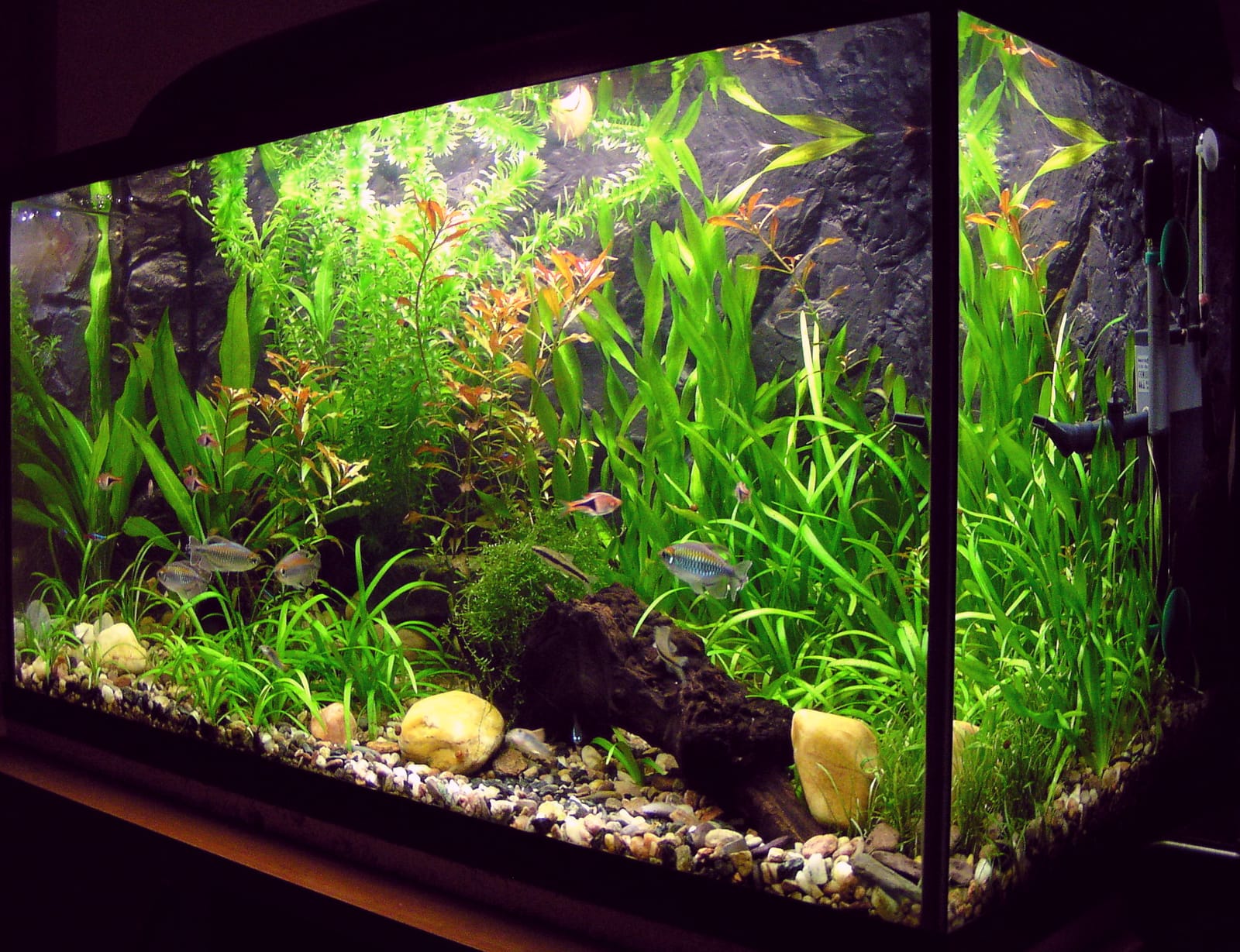
Every guide that discusses breeding shrimp with rasboras says the same word: moss. Newborn shrimplets spend their first weeks inside whatever fine-leaved cover is nearest to where they hatched, and a rasbora can't eat what it can't reach. What works, in order of how much difference it makes:
- •A large moss mass. Java moss, Christmas moss or a moss-wrapped piece of driftwood the size of your fist. Our best moss for shrimp tanks guide compares the options. One golf ball of moss is a decoration; a clump you can lose your hand in is a nursery.
- •Fine stem plants. Rotala, hornwort, guppy grass, anything dense enough that a fish has to work to get through it.
- •Leaf litter. A few Indian almond or oak leaves give shrimplets a roof, grow biofilm for them, and suit the rasboras' blackwater origins.
- •Floating plants. Seriously Fish recommends floating cover to dim the light for Boraras. Calmer fish spend more time in the school and less time poking around.
The rule of thumb from our how to raise shrimplets guide holds: if you can see bare substrate across more than about a third of the floor, there isn't enough cover for a breeding colony with fish in it.
Numbers: Fish, Shrimp and Tank Size
A small group of rasboras is a nervous group, which is why every source insists on 8 to 10 as a floor. Shrimp colonies have their own minimum: Aquarium Co-Op suggests at least 10 Neocaridina to guarantee both sexes, and a colony of 10 has no margin for losses.
| Tank | Rasboras | Shrimp to start | Notes |
|---|---|---|---|
| 10 gallon | 8 to 10 chili or phoenix | 10 to 20 cherry shrimp | Boraras only. Lambchops and harlequins want a longer tank |
| 20 long | 10 to 12 of any species | 20 to 30 | The sweet spot. Room for a moss mass and a school |
| 29 to 40 gallon | 12 to 20 of any species | 30 to 50 | Harlequin territory. Shrimp breed faster than the fish can eat |
Two timing rules matter more than the counts. Shrimp first, fish later: let the colony breed for two to three months before the rasboras go in. Once you're seeing berried females every week, a school won't dent the numbers. Filter for the babies: a sponge filter like the Hikari Bacto-Surge won't pull shrimplets in the way a hang-on-back intake can. If you run a canister or HOB, put a sponge over the intake.
Feeding Both Without Fouling the Water
Rasboras eat from the water column and want small food: crushed krill flakes, baby brine shrimp, frozen cyclops and Daphnia on Aquarium Co-Op's and Seriously Fish's lists, or any micro pellet sized for nano fish (a search for nano fish micro pellets turns up several). Shrimp graze biofilm all day and need a supplemental feeding only two or three times a week.
The routine that keeps both fed and the nitrates down: feed the rasboras a small pinch once a day, gone in a minute or two before it reaches the bottom. Whatever sinks is the shrimp's share. Two or three times a week, drop a shrimp food or a quarter of an algae wafer into the moss where the fish can't reach it. A well-fed rasbora spends less time hunting the moss, and that's the cheapest shrimplet protection there is.
Frequently Asked Questions
◆Will chili rasboras eat cherry shrimp?
Not adults. Chili rasboras top out under an inch and feed in the middle of the water column, and Aquarium Co-Op names them as a cherry shrimp tank mate in its own care guide. They'll eat a newborn shrimplet they find in the first few days after hatching, but in a mossy tank the colony keeps growing.
◆Are harlequin rasboras safe with shrimp?
Safe with adults, riskier with babies than the smaller rasboras. At up to 2 inches a harlequin can take shrimplets for a couple of weeks after they hatch. Keep 8 or more so they school instead of wandering, plant heavily, and let the shrimp breed for a few months before adding the fish.
◆Which rasbora is best for a shrimp tank?
Phoenix or chili rasbora. Both stay under an inch, hang in the upper water, and are listed by Seriously Fish as suitable with Caridina and Neocaridina. Phoenix rasboras are the more acid-loving fish and suit Caridina water best; chilis have the wider published pH range for a cherry shrimp tank.
◆How many rasboras can I keep in a 10 gallon shrimp tank?
Eight to ten chili or phoenix rasboras. That's the minimum school size every source gives, and their bioload is small enough that a planted 10 gallon with a cherry colony handles it. Lambchops and harlequins want a 20 long or bigger.
The Bottom Line
Rasboras and shrimp is a pairing that actually works. Adults are safe with all four species, and the babies are safe in proportion to how much moss you grow and how small the fish is. Pick a Boraras for a 10 gallon or a Caridina tank, a harlequin or lambchop for a warm 20 long, add the fish after the shrimp are established, and feed the school so it doesn't go looking.
For how rasboras compare with otos, corys and the rest, our best tank mates for cherry shrimp guide ranks the whole field.
Found this helpful?
Check out our other shrimp care guides