Cherry Shrimp Eggs: What They Look Like and When They Hatch
Cherry shrimp eggs explained: saddle vs berried, why eggs are yellow or green, when the eyes show, hatch times by temperature, dropped and white eggs, and clutch size.
📅 Published 2026-10-07
You spotted a yellow patch on the back of one of your females, or a cluster of little spheres under her tail, and now you're checking the tank every ten minutes. Cherry shrimp eggs are easy to see once you know where to look, and the female does almost all the work. What trips keepers up is the waiting: eggs that change color, a clutch that looks smaller than yesterday, a female that was berried on Tuesday and isn't on Friday.
This guide is about the eggs themselves, from saddle to hatch: what's normal, what isn't, and how long each stage takes. The tank setup and the how-to of getting shrimp to breed is already in our breeding cherry shrimp guide, so we won't repeat it here.
Quick Answer
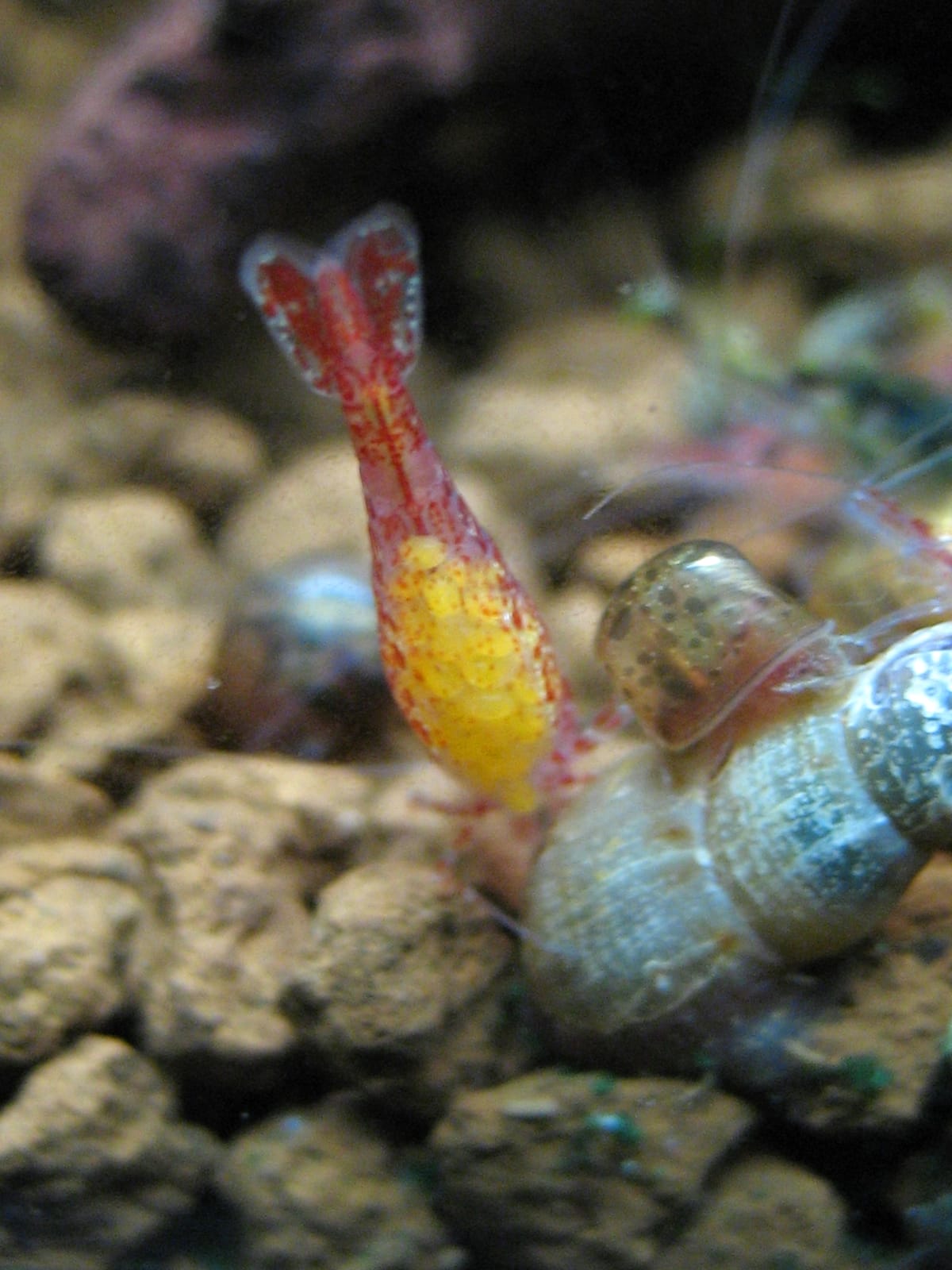
Cherry shrimp eggs are round, about a millimeter across, and yellow or green. Before mating they show as a colored saddle behind the female's head. After mating she moves them under her tail and carries a clutch most sources put at 20 to 30 eggs. Eggs darken and turn translucent as they develop, two black dots (the eyes) appear in the last few days, and they hatch after roughly three to four weeks at typical tank temperatures, faster when warm and slower when cool. The babies come out as fully formed miniature shrimp.
Dropped eggs and white or fuzzy eggs are the two things that go wrong, and both usually trace back to stress or a water swing rather than anything wrong with the shrimp.
Saddle vs Berried: The Two Stages
The saddle is a patch of color behind the head, on top of the body, that curves down either side like a saddle on a horse. Those are unfertilized eggs developing in the ovaries. Wikipedia's Neocaridina davidi entry describes it as "a green or yellow triangular 'saddle' marking," and Aquarium Co-Op's care guide calls it a yellow, saddle-like shape of unfertilized eggs. A saddled female is ready to mate but hasn't yet. Only females get one, so it's also the most reliable way to sex your shrimp; our male vs female cherry shrimp guide shows the other differences.
Berried means the eggs have been fertilized and moved to the swimmerets, the small legs under the tail. The female mates right after she molts, while her new shell is still soft, and Shrimply Explained says she transfers the eggs to her underside within an hour or two of mating. From then on she holds and fans the clutch until it hatches.
How long between saddle and berried? Less predictable than most guides admit. Mustafa, who runs the Petshrimp forum, puts it at anywhere from a few days to a few weeks depending on how developed the eggs in the ovary already are. A saddled female with no males in the tank stays saddled and never berries, which is the usual reason a "breeding" colony never produces babies.
What Cherry Shrimp Eggs Look Like
Fresh eggs are small, round, and opaque. Shrimply Explained describes them as "relatively opaque yellow spheres, but they can also be green, white, or even blue," with yellow and green being what you'll see on cherry shrimp. Betta Care Fish Guide gives an average egg length of about 1.2 mm: each egg is roughly a grain of coarse sand, and the clutch under the tail looks like a bunch of tiny grapes.
The female keeps them in constant motion. Her swimmerets beat over the clutch to push fresh water across the eggs; Aquarium Co-Op and The Shrimp Farm both describe this fanning as what stops fungus and bacteria growing on them. A berried female tucked in the moss with her tail flicking rhythmically is doing exactly that, and it's a good sign. She'll also rearrange the eggs with her back legs now and then, which is normal. What she won't do is pull them out of the egg pocket entirely unless something is wrong.
Yellow Eggs vs Green Eggs, and Why the Color Changes
This is the question that generates the most worry, and the answer is mostly "genetics."
Whether a female carries yellow or green eggs is set before she's ever berried. Wikipedia states plainly that "the eggs are green or yellow, depending on the color of the saddle," and the same female tends to carry the same color clutch after clutch. Aquarium Culture adds that green eggs turn up more often on females with lighter or browner body color than on solid, deeply red ones. The Shrimp Farm's breeding article makes the other important point: egg color does not affect the color of the babies. Green eggs from a red female hatch into normal cherry shrimplets.
The change over the incubation period is a separate thing. The Goldfish Tank says yellow eggs shift toward green or brown as they develop, Betta Care Fish Guide describes them going a darker brown, Wikipedia says they "gradually darken during incubation," and Shrimply Explained frames it as the eggs becoming more translucent. All four describe the same process: the yolk is being used up and the shrimplet is taking shape, so the egg looks less like a solid bead and more like a tiny dark blob inside a clear shell. A clutch that started bright yellow and now looks olive or muddy is on schedule. Eggs turning white or milky are the opposite direction, covered later.
When the Eyes Appear
The single most useful milestone. A few days before hatching, each egg develops two tiny black dots, one on either side. Those are the eyes of the shrimplet inside. Wikipedia notes that "tiny dark eye spots of the developing shrimp within can be observed" near the end of incubation, and Shrimply Explained says the two black spots mean hatching is a few days out.
You'll need to look closely, ideally with the female on the glass or a pale leaf, and a zoomed-in phone camera helps. Once you see eyes, stop doing anything to the tank. No water change, no rescaping, no moving her. A stressed female this close to the finish can still drop the clutch.
How Long Cherry Shrimp Eggs Take to Hatch
Here the sources genuinely disagree, so here's the spread rather than a single number:
| Source | Incubation time |
|---|---|
| Wikipedia (Neocaridina davidi) | 2 to 3 weeks |
| UK Shrimp | 2 to 3 weeks (14 to 21 days) |
| Hygger | 14 to 21 days |
| Shrimply Explained | 15 to 30 days at normal tank temperatures |
| Aquarium Co-Op | about 30 days, depending on temperature |
| Aquarium Breeder | 25 to 35 days, shorter at higher temperatures |
That's a range of two to five weeks, and the reason is temperature. Every one of those sources says warmer water speeds development and cooler water slows it, and they're measuring at different temperatures. In a tank in the mid 70s F, three to four weeks is the realistic expectation. At 78 to 80F it can be closer to two and a half; at 68 to 70F it can stretch past a month. If your female has been berried 30 days with no eyes showing, check the thermometer before you assume something's wrong.
Don't crank the heater to hurry things. Hygger notes shrimp get stressed above 80F, and Aquarium Co-Op points out that warmer water speeds growth and breeding but shortens lives. Our shrimp tank temperature guide explains why a stable mid 70s beats chasing a number.
Betta Care Fish Guide describes hatching as gradual rather than all at once, and that matches what keepers see: a female half berried one morning and empty by the next evening. A shrinking clutch with no white eggs and no shed shell lying around is a hatch, so look for shrimplets in the moss instead of panicking.
How Many Eggs, and What Hatches Out
Most published figures agree on clutch size. Wikipedia, Aquarium Co-Op, The Goldfish Tank, and Hygger all give 20 to 30 eggs per batch. Aquarium Breeder reports a wider 21 to 51, noting that larger females carry more. Both can be true: a young female's first clutch is often small, and a big, well fed adult pushes the upper end. Expect 20 to 30 and treat 40 plus as a bonus from an older female.
The babies are exact copies of the adults, just tiny and mostly clear. How tiny is another point where sources differ: Wikipedia says roughly 1 mm, Aquarium Co-Op says 1/16 inch (2 mm), and Shrimply Explained says about 3 mm. Either way they vanish in a planted tank for the first week, so a "failed" hatch is often a successful one you can't see yet. Shrimply Explained notes they carry a bit of yolk for their first several days, then graze biofilm like the adults. Our how to raise shrimplets guide covers keeping them alive from there.
When do those babies start carrying eggs of their own? Sources spread from about two months (Wikipedia, Shrimply Explained) to four to six months (The Shrimp Farm), with Aquarium Co-Op in between at three to five. Warm, well fed colonies land at the short end.
Dropped Eggs: Why It Happens
A female that was berried yesterday and clean today either hatched (were eyes showing? any babies?) or dropped. Dropping is common in new colonies and rarely the female's fault. The causes, roughly in order of likelihood:
A water change or parameter swing. ShrimpKeepers lists this first, and Shrimp Sanctuary makes the same point about new tanks: even small fluctuations in temperature, TDS, or pH can make a female release the clutch. The mechanism is often a forced molt, because if a berried female molts, the eggs go with the old shell. Aquarium Breeder describes females molting with the eggs still attached to the shed exoskeleton and losing the whole brood, and ShrimpKeepers says the same. A big, cold water change is the classic trigger.
First-time mothers. Both ShrimpKeepers and Shrimp Sanctuary call this normal. Young females often don't fan or hold the clutch properly the first time and drop some or all of it. ShrimpKeepers says most improve by their second or third batch, so don't cull a female for one lost clutch.
Harassment. Males that won't leave her alone, or fish nosing at her, push a female to hide and sometimes to release eggs. Aquarium Co-Op's breeding article notes that females close to hatching hide in the dark and "if startled, may abandon their eggs."
Bad water. Ammonia, nitrite, or high nitrate. Acuario Pets sums it up: females won't carry eggs in conditions that feel unsafe, and they release them early if the tank goes downhill.
Shrimp Sanctuary adds that a female who drops two or three cycles in a row is signaling something beyond bad luck, either water problems or, in heavily inbred lines, genetics.
The practical advice is simple. While you have berried females, do smaller water changes with temperature matched water, don't rescape, and don't move her to a breeder box "to keep her safe." Netting a berried female is the most reliable way to make her drop. Keep feeding a staple like Shrimp King Complete in small amounts and resist feeding extra "for the eggs," because fouled water is what makes her drop the clutch. The full cycle from molt to pheromones to mating is in how do shrimp reproduce if you want the biology behind it.
White Eggs, Fuzzy Eggs, and Odd Green Growths
Healthy eggs are yellow, green, or darkening toward brown. Three other looks mean trouble:
White or opaque eggs are unfertilized or dead. ShrimpKeepers says they cannot be saved, and The Goldfish Tank describes unfertilized eggs as lighter and opaque, which the female usually picks out and discards herself. A whole white clutch means the fertilization didn't take. Nothing to do but wait for the next cycle.
Fuzzy eggs are fungused. ShrimpKeepers notes infected eggs look fuzzy or discolored before the female abandons them. That usually happens when fanning stops, which points back to a stressed or sick female rather than a problem with the eggs.
Uneven green growths that look feathered or bumpy rather than smooth and round may not be eggs at all. Aquarium Culture describes this as a possible sign of Ellobiopsidae, a parasite that gets mistaken for a green clutch. We found only one source for that, so treat it as a reason to look closer: real eggs are uniform spheres, and anything with a ragged edge isn't one.
Can You Hatch Dropped Eggs?
Sometimes. Eggs left on the substrate fungus or get eaten within a day or two; The Goldfish Tank says they rarely hatch outside the female's care, and Betta Care Fish Guide puts the odds at slim to none without help.
The workaround is an egg tumbler, a small chamber where an airline keeps the eggs gently moving so water flows over them the way her swimmerets would. ShrimpKeepers gives the method: collect the eggs with a pipette, tumble them on a gentle bubble stream, change half the water daily with tank water, and wait. Eggs must keep moving, because still eggs fungus. They report 50 to 70 percent success for eggs already showing eye spots and lower for early ones, though that's one guide's figure. For a $5 cherry shrimp it's rarely worth the fuss, since the next clutch is three weeks away; for an expensive line or a clutch with eyes already showing, it's cheap enough to try.
Frequently Asked Questions
◆How long does it take for cherry shrimp eggs to hatch?
Usually three to four weeks at typical tank temperatures in the mid 70s F. Sources range from two weeks to five, and the difference is temperature: warmer water hatches faster, cooler water slower. Eyes appear as black dots a few days before hatching.
◆Why are my cherry shrimp eggs green instead of yellow?
Egg color is genetic and matches the color of the female's saddle. Green eggs are just as viable as yellow ones and hatch into normally colored shrimplets. Eggs also darken toward green or brown as they develop, so a yellow clutch turning olive is on schedule.
◆What does a saddle on a cherry shrimp mean?
A saddle is the yellow or green patch behind a female's head. It's unfertilized eggs developing in her ovaries and means she's ready to mate. After she molts and mates, the eggs move under her tail and she's "berried." A saddled female without a male stays saddled.
◆Why did my berried shrimp drop her eggs?
Most often a water change or parameter swing that stressed her or triggered an early molt, since eggs go with the shed shell. First-time mothers also drop clutches while they learn. Keep water changes small and matched, don't net her, and she'll usually hold the next batch.
The Bottom Line
Cherry shrimp eggs go from saddle to berried to eyes to babies over about a month, and the female handles every step if the water stays still. Yellow or green is genetics, darkening is development, white is dead, and a suddenly empty female either hatched or got stressed into dropping. Keep water changes small while she's carrying, leave her alone once the eyes show, and read breeding cherry shrimp for the tank setup that makes the next clutch a sure thing.
Found this helpful?
Check out our other shrimp care guides