Male vs Female Cherry Shrimp: How to Tell Them Apart
Male vs female cherry shrimp, ranked by how reliable each sign is: saddle, eggs, belly curve, size, and color, plus why the biggest shrimp isn't always male.
📅 Published 2026-09-15
Telling male vs female cherry shrimp apart is easy once you know which signs to trust and which ones only hint. Two signs are proof: a saddle behind the head, or eggs under the tail. Everything else, from body shape to size to color, is a probability that gets stronger the more of them line up.
This guide ranks the signs by how reliable they are, puts them side by side in a table, and covers the two mistakes behind most wrong calls: reading a saddle as an illness, and assuming the biggest shrimp in the tank is a male.
Quick Answer
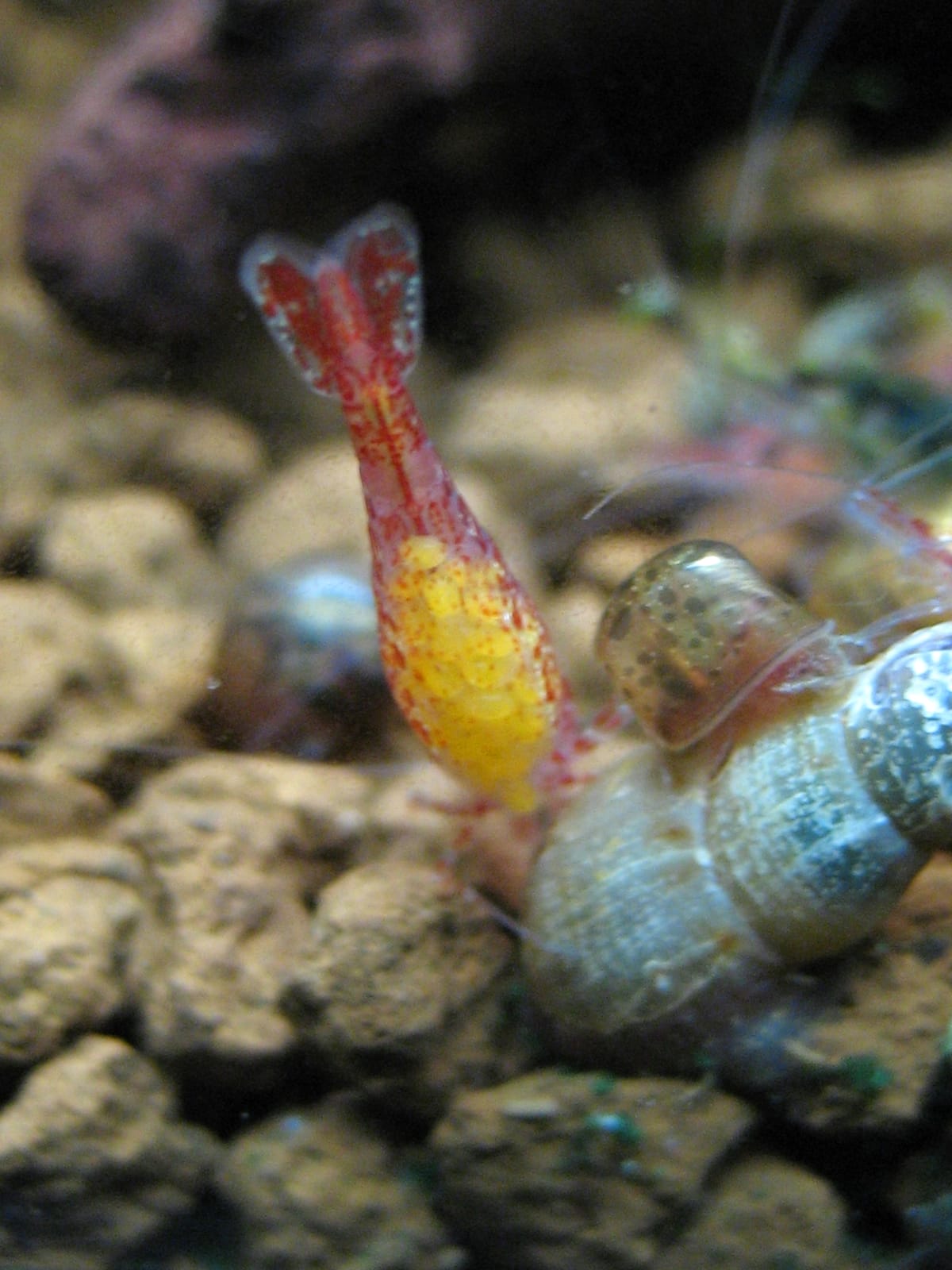
A cherry shrimp with a yellow or green saddle-shaped patch behind its head, or with a cluster of eggs held under its abdomen, is a female. No male ever shows either. Beyond those two, adult females are larger (up to about 1.5 inches), have a deeper abdomen that curves down like a "D" on its side, and usually carry more solid color. Males are smaller, slimmer, flat along the belly, and often paler or more see-through.
Below about 1 cm the sexes look alike. Sources put reliable sexing anywhere from 2 to 4 months of age, so give juveniles time before you count them.
How to Tell If a Cherry Shrimp Is Male or Female: The Signs, Ranked
Here's each sign in order from proof to hint. Shrimp Science, The Shrimp Farm, and Aquariumbreeder all rank them roughly this way.
◆1. Berried eggs: proof of a female
If a shrimp is carrying eggs under its abdomen, held between the swimmerets like a bunch of tiny grapes, it's female. Full stop. The eggs are usually yellow or green, sometimes orange or brown depending on the line, and she fans them constantly to keep them oxygenated. Shrimp Science and Acuario Pets put the clutch at 20 to 30 eggs, with larger females carrying more, held for around 3 to 4 weeks before hatching. Shrimply Explained says 15 to 30 days; warmer water runs shorter.
◆2. The saddle: proof of a female
A saddle is a patch of developing, unfertilized eggs in the ovaries. It shows through the shell as a yellowish, greenish, or sometimes whitish mark on the back just behind the head, and its shape gives it the name. Only females have ovaries, so only females have saddles. Superior Shrimp notes that young females often develop one before they're old enough to breed, so it can identify a female earlier than size will.
The saddle isn't always visible. In high-grade, fully opaque lines the shell can hide it, and a female who has just moved her eggs to her swimmerets won't show one until the next batch develops. A missing saddle proves nothing; a present one proves female.
◆3. Abdomen shape: strong evidence
Look at the shrimp side-on. A mature female has a smooth, curved underside to the abdomen, so the tail section looks like a letter D on its flat side; that curve is where she'll hold eggs. A male's underside runs nearly straight from carapace to tail, and the back half looks narrower and more triangular.
There's a finer version of this: the big plate on the second abdominal segment. On a female it's wider at the base and rounder, almost a circle; on a male it stays straight-edged. Shrimply Explained, The Shrimp Farm, and Aquariumbreeder all point to this plate (The Shrimp Farm counts it as the first, the others as the second; either way it's the big one), and it's the tell that works when there's no saddle to see. Aquariumbreeder adds that a female that has been berried before keeps the rounded belly permanently, so an older female reads as female even between clutches.
◆4. Size: useful only with context
Adult females are bigger. How much bigger depends on who you read: Aquatic Arts, Aquarium Co-Op, and Shrimply Explained put females at up to 1.5 inches (3.8 to 4 cm) and males at 1 to 1.25 inches or less; Aquariumbreeder says females around 1 inch and males two thirds to three quarters of that; Superior Shrimp gives 25 to 35 mm for females and 18 to 25 mm for males. The direction is the same everywhere; the numbers aren't.
The catch is age. A four-month-old female is smaller than a ten-month-old male, so size only tells you something between shrimp of roughly the same age, which in a colony that's been breeding for a year you can't know. Aquariumbreeder rates size as low reliability for this reason.
◆5. Color intensity: a hint, not proof
In most cherry lines, females carry deeper, more solid color and males look paler, more translucent, or patchy with speckles of red on a clear body. Shrimp Science, Aquatic Arts, Acuario Pets, and Aquariumbreeder all say so, and in a mid-grade colony it's the first thing you'll notice.
It breaks down in two places. High-grade lines (painted fire reds, bloody marys) have been bred for opaque color in both sexes, so the males are as red as the females. And a stressed or freshly molted female can go pale for a day. One or two guides claim males are the more colorful sex; that's a minority view and doesn't match what the major shrimp retailers report.
◆6. Antennae and swimmerets: for the patient
Two more signs need a close look. Males tend to have longer antennae; Shrimply Explained's rule is that a female's antennae are about three quarters of her carapace length or shorter, while a male's often exceed his carapace. Aquariumbreeder rates this as low reliability without practice.
Swimmerets differ too. Females have rounder, more developed swimmerets for cupping eggs; males' are longer and more pointed, and under magnification the first two pairs on a male carry reproductive structures. Useful with a macro lens, not from across the room.
Male vs Female Cherry Shrimp: Side-by-Side
| Sign | Female | Male | Reliability |
|---|---|---|---|
| Eggs under abdomen | Yes, 20 to 30 per clutch | Never | Proof |
| Saddle behind head | Yes, when eggs are developing | Never | Proof (if present) |
| Abdomen underside | Curved, D-shaped | Straight, triangular | Strong |
| Second abdominal plate | Wide, rounded | Narrow, straight-edged | Strong |
| Adult size | 1 to 1.5 inches | 0.75 to 1.25 inches | Only with known age |
| Color | Deeper, more solid | Paler, more translucent | Hint; fails in high-grade lines |
| Antennae | Shorter, about 3/4 of carapace | Longer than carapace | Weak |
| Swimmerets | Rounder, more developed | Longer, pointed | Needs magnification |
| Behavior after a molt | Hides | Swims frantically searching | Situational |
How Old Do Cherry Shrimp Need to Be Before You Can Sex Them?
Not as young as you'd like. Below about 10 to 12 mm, Superior Shrimp says males and females are nearly impossible to tell apart, and suggests waiting until 15 mm before trusting size. Aquariumbreeder puts naked-eye sexing at around 2 months old. Shrimply Explained and Acuario Pets say the differences become obvious at sexual maturity, roughly 75 days. Other guides say wait 3 to 4 months, or half to three quarters of an inch.
Sources disagree on maturity itself: Shrimp Science puts it at 4 to 6 months, Shrimply Explained at 75 days. Temperature explains much of the gap; shrimp in a 78F tank mature faster than in a 70F tank.
One data point from outside the hobby: a 2019 study in the Canadian Journal of Zoology (Tropea and López Greco) raised cherry shrimp juveniles for 50 days before sexing them, and found the sex ratio held at 1:1 regardless of which adults they were raised with. So sex appears to be set genetically rather than by the social environment, and any random batch of shrimplets, or any unsorted bag from a seller, is roughly half male, half female.
In practice: don't try to sex anything under a centimeter. Wait until a shrimp is 1.5 cm or so, or until the first saddles appear in the batch, then sort.
Why Sexing Cherry Shrimp Matters
Building a breeding colony. The usual advice is 2 to 3 females per male; Superior Shrimp says it outright and Aquariumbreeder gives 1:2 or 1:3. Shrimp Science goes further and suggests 20:80 male to female for the fastest growth. Too many males and females get chased after every molt; too few and clutches go unfertilized. You don't have to hit the ratio precisely, but if you're moving shrimp between tanks it pays to know what you're moving.
Buying a starter group. Aquarium Co-Op's advice is to buy at least 10, which more or less guarantees both sexes. They also warn against hand-picking only the biggest shrimp in the shop tank, since those may all be one sex (usually females) or too old to breed well. Take a mix of sizes, and take any shrimp with a saddle. Our breeding cherry shrimp guide covers what to do once they're home.
Understanding "all my shrimp are pale." Half the time the answer is that the keeper is looking at males. A group of six pale, small, straight-bodied shrimp that never berry is probably six healthy males. Knowing what a male looks like turns a water-quality panic into a shopping trip for females.
Diagnosing a colony that isn't breeding. Before you change parameters, count. Ten females and no males never breed, and neither do ten males. Saddled females for months with no berried ones means you're short on males. Our guide to why shrimp aren't breeding walks through the rest of the list once you've ruled that out.
Common Mistakes When Sexing Cherry Shrimp
Reading a saddle as a disease. New keepers see a yellow or whitish patch behind the head and search for parasites; the FishLore forum has a thread titled simply "What is the yellow line?" from exactly this worry. It's a saddle, and it means she's healthy, well fed, and about to breed. Disease looks different: a cloudy or milky body, a white ring at the carapace joint, or a shrimp lying on its side. A sharply defined patch high on the back of an otherwise active shrimp is eggs.
Assuming the biggest shrimp is male. In cherry shrimp it's backwards: the largest shrimp in any colony is almost always a mature female. If your "alpha male" turns up berried one morning, that's why.
Sexing by color in a high-grade colony. Bloody marys and painted fire reds have opaque males. Sort those by color and you'll pull females out and leave the males behind. Use the belly curve and the second plate instead.
Sexing juveniles. A 7 mm shrimp is a 7 mm shrimp. Anyone who tells you they sorted a batch of two-week-old shrimplets by sex was guessing.
Mistaking a freshly molted female for a male. Right after a molt a female is paler and her shell is soft and clear. Give her a day. If males are zipping around the tank with no obvious target, a female has just molted somewhere in there.
A Five-Minute Method for Counting Your Colony
Drop a Hikari algae wafer on an open patch of substrate and wait 10 minutes. Most of the colony will gather on it side-on in decent light, the best sexing view you'll get without a net.
Count in three passes. First: anything berried or saddled is female. Second: of the rest, anything with a clear D-shaped belly or a wide rounded second plate is likely female. Third: the small, straight, pale ones are your males. Ignore anything under about 1.5 cm.
Write the numbers down. One male to two or three females is fine, and so is one to one. A colony with no confirmed females after two months of watching, or no males, is your problem, and a cheap one to fix. The shrimp anatomy guide explains the saddle, swimmerets, and abdominal plates if you want names for what you're looking at, and how shrimp reproduce covers what happens after the female molts.
Frequently Asked Questions
◆Can you tell the sex of a cherry shrimp by color alone?
Not reliably. In mid-grade lines females are more solid and males paler, so color is a decent first hint. In high-grade lines like bloody mary and painted fire red both sexes are opaque, and a freshly molted or stressed female goes pale. Confirm with a saddle, eggs, or the belly curve.
◆What does a saddle look like on a cherry shrimp?
A yellowish, greenish, or whitish patch high on the back just behind the head, shaped a bit like a horse's saddle. It's developing eggs in the ovaries, seen through the shell. Only females have one, and it means she's healthy and will breed after her next molt. It isn't a disease.
◆Are male or female cherry shrimp bigger?
Females. Adult females reach 1 to 1.5 inches depending on the source; males top out around 0.75 to 1.25 inches. The largest shrimp in a colony is nearly always a mature female. Size only helps between shrimp of the same age, so use it alongside the belly shape.
◆How many males do I need in a cherry shrimp colony?
Most guides suggest 1 male for every 2 to 3 females; Shrimp Science recommends as few as 1 in 5 for the fastest growth. A random group of 10 is close to half and half, which works fine. Too few males means unfertilized clutches; too many means females are chased after every molt.
◆At what age can you sex cherry shrimp?
Sources range from about 2 months to 4 months, or roughly 10 to 15 mm in length. Below 1 cm the sexes look identical. Saddles sometimes show on young females before size differences do, so watch for those first. Warmer tanks mature shrimp faster.
The Bottom Line
Two signs are proof: eggs or a saddle means female. After that, trust the belly curve and the second abdominal plate, use size only against shrimp of the same age, and treat color as a hint. Wait until juveniles hit 1.5 cm before sorting them. Once you can read your colony, most breeding questions answer themselves, and our cherry shrimp care guide covers the rest of keeping them.
Found this helpful?
Check out our other shrimp care guides