Can Shrimp Live With Endlers? A Gentler Guppy for Shrimp Tanks
Can shrimp live with endlers? Yes. These tiny livebearers are gentler on a shrimp colony than guppies, and here is how to keep both and save the babies.
📅 Published 2026-10-25
Endler's livebearers and cherry shrimp show up on the same beginner shortlists, and for good reason. Both are small, both are colorful, both breed on their own, and both want the same kind of water. The short version is that they get along well, and better than most people expect, because an Endler is a smaller, less hungry fish than the guppy it looks like.
The one honest catch is the same as with any small fish in a shrimp tank. A grown shrimp is safe, but a newborn shrimplet is the size of a comma, and a fish with a mouth will take it if it can. Whether your colony keeps climbing depends on how much cover you give the babies, not on whether the Endlers "like" shrimp. This guide walks through the real risk, how to tilt the odds toward the shrimp, why the water match is almost perfect, and how to keep the Endlers from taking over the tank.
Quick Answer
Yes, shrimp and Endlers can live together, and Endlers are one of the better fish for a shrimp tank. Adult cherry shrimp are too big for an Endler to eat, and the two share the same hard, slightly alkaline water. The only limit is baby shrimp. Endlers will pick off newborn shrimplets if the tank is bare, so a layout thick with moss and hiding spots is what lets the colony keep growing.
Endlers are a gentler choice than guppies here. They top out around an inch, their mouths are smaller, and the breeder retailer The Shrimp Farm calls them "generally considered one of the best fish for freshwater shrimp tanks." Expect to lose a few babies anyway, plant heavily, keep the fish fed, and both populations can boom in the same box of water.
Endlers Are Not Quite Guppies
People treat Endlers and guppies as the same fish, and they are close relatives that interbreed, but the size difference is the whole story for a shrimp keeper.
A male Endler (Poecilia wingei) runs about an inch long. The Shrimp Farm lists males at 1 to 1.5 inches, the UK retailer FishKeeper gives a maximum of 2.5 cm, which is just under an inch, and the care site Aquariadise puts males at 1 inch with females around 1.8 inches. A common guppy male is noticeably bigger, often 1.5 to 2 inches, and a female guppy bigger still. That gap matters because predation on shrimp is a mouth-size problem. A smaller fish can only swallow smaller prey, so an Endler that is physically able to eat a two-day-old shrimplet still cannot touch a juvenile that a guppy would happily chase down.
So when our guppies and shrimp guide says guppies readily eat shrimplets, the verdict for Endlers is a step milder. They eat fewer babies, they stop being a threat to the shrimp sooner as the babies grow, and keepers routinely report both species breeding at once. That does not make them harmless to fry. It makes them the safer of the two look-alikes.
Will Endlers Eat Your Shrimp?
It comes down to the size of the shrimp, exactly as it does with any small community fish.
Adult shrimp are safe. A full grown cherry shrimp is a bit over an inch and far too bulky for an inch-long fish to swallow. The Shrimp Farm states plainly that Endlers "rarely bother adult shrimp," and forum keepers say the same, that the fish ignore adults and reasonably sized juveniles and only bother the tiniest babies.
Shrimplets and fresh molts are at risk. A newborn shrimp is a few millimeters long and pale, and a freshly molted adult is soft and slow for a few hours. Those are the ones an Endler can and will eat. The Shrimp Farm's own page is honest about it: Endlers "may occasionally eat very tiny newborn shrimp (shrimplets), especially in sparsely decorated aquariums." A compatibility database I came across tags Endlers as a fry predator, which is the right label. The predation is real but light.
The practical read is that an Endler tank is a survivable place for a shrimp colony, not a sterile one. In a bare tank the babies have nowhere to go and the colony stalls. In a jungle, enough slip through that the shrimp outbreed the losses and the numbers climb. You are not stopping predation, you are outrunning it.
How to Keep Shrimp and Endlers Together
Every tactic here does one job: get shrimplets to a size the fish cannot eat. Stack as many as you can.
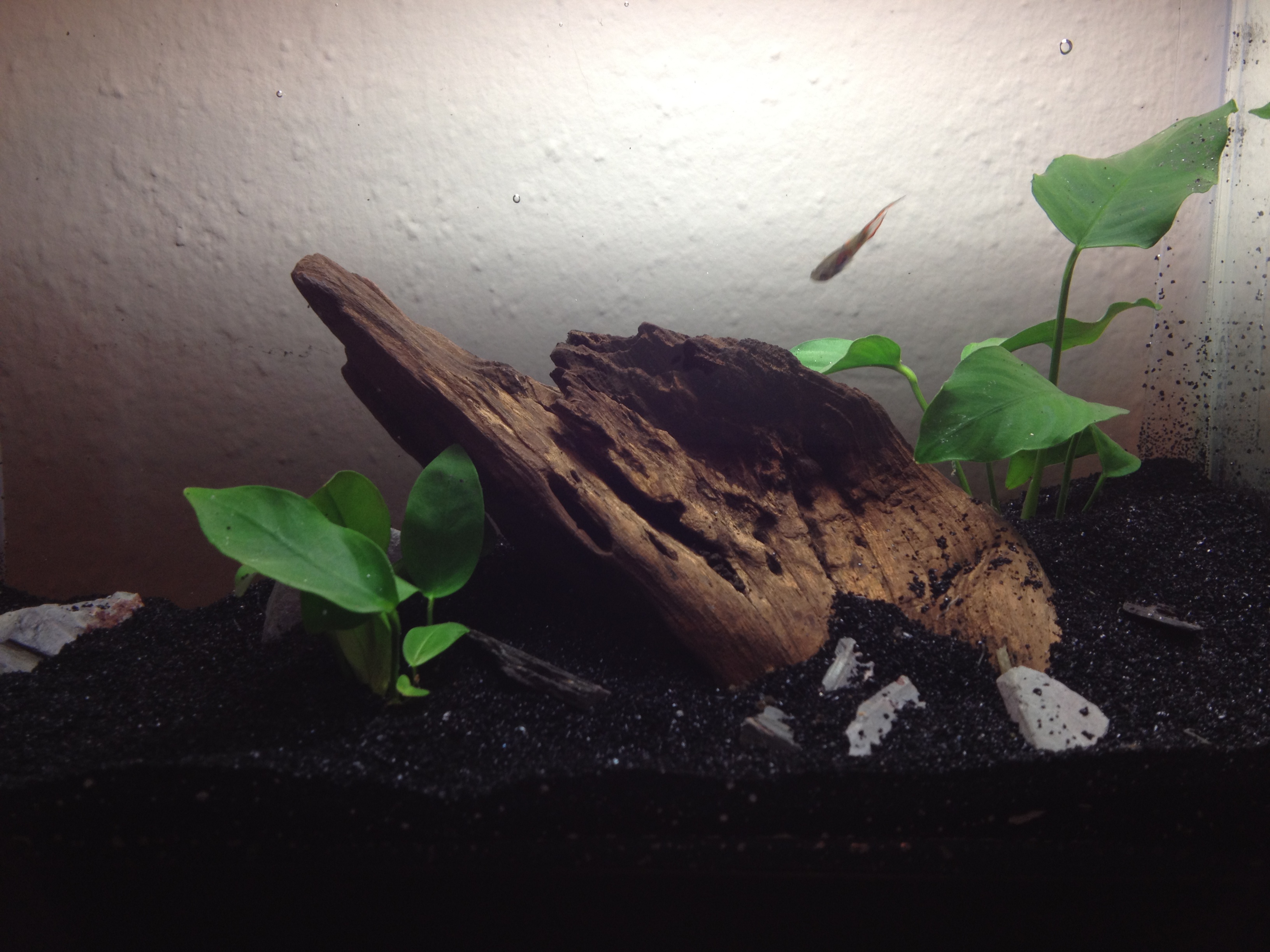
Plant heavily, moss first. Dense moss is the single best thing in the tank for baby survival. Shrimplets vanish into a clump of Java moss and graze inside it, out of reach, until they are too big to be a snack. Pile it on driftwood, let it get shaggy, and add floating plants so the surface is broken up too. You can grab a starter portion of aquarium Java moss cheaply and tie it to almost anything.
Break up the hardscape. Driftwood, cholla wood, rock piles, leaf litter, and shrimp caves all add corners a fish cannot follow a baby into. The more cluttered and three dimensional the layout, the more fry make it.
Keep the Endlers full. A well fed fish hunts less. Feed a quality flake or small pellet on a regular schedule so the Endlers are not cruising the moss for extra protein between meals.
Start the shrimp first. Put the shrimp in, let them settle and breed for a month or two, then add the Endlers to an established colony. A breeding colony that is already a few dozen strong can absorb some losses and still grow, where a fresh handful of shrimp cannot.
Go bigger if you can. A 10 gallon is the sensible floor for this pairing, and 20 gallons gives both species more room and more hiding space. More water also rides out the Endler breeding explosion covered below.
Water Parameters: A Near Perfect Overlap
This is where Endlers shine as a shrimp mate. They want the same water as hardy Neocaridina shrimp, and in one way they want it even more.
| Parameter | Endler's livebearer | Neocaridina (cherry) shrimp |
|---|---|---|
| Temperature | 72 to 82F | 65 to 80F, best 72 to 78F |
| pH | about 7.0 to 8.0 | 6.5 to 8.0 |
| Hardness | moderate to hard, alkaline | moderately hard, GH 6 to 8 |
| Tank size | 10 gallons and up | 5 gallons and up |
The sources do argue about the edges of the Endler range. The Shrimp Farm's quick facts give pH 7.0 to 8.0 while its care text widens that to 6.5 to 8.0. FishKeeper pushes the top end up to pH 8.5 and describes the ideal as hard, alkaline water. Aquariadise lists a much wider tolerance, pH 5.5 to 8.0 and temperatures from the mid 60s to the mid 80s. Read together, the comfortable zone everyone agrees on is roughly pH 7.0 to 8.0 and 72 to 82F, with the outer numbers being limits rather than targets.
Here is the useful part for a shrimp keeper. Neocaridina want hard water with plenty of minerals, because those minerals are what build a shrimp's new shell after each molt. Endlers want hard, alkaline water too. You are not compromising between two animals, you are keeping both in the water they each prefer. Set it up with the numbers in our water parameters guide and you have a tank that suits the fish and the shrimp at once.
The flip side is a hard no. This pairing only works with Neocaridina. Soft water Caridina shrimp, the crystal reds and Taiwan bees, want acidic water down around pH 5.5 to 6.5, which is wrong for Endlers and a fight you will not win. If your heart is set on Endlers, keep cherries, blue dreams, or another Neocaridina, and leave the Caridina for a species tank of their own.
The Endler Population Problem
Nobody warns new keepers about this, so here it is. Endlers are livebearers, and they breed as fast as the shrimp do, maybe faster. A female drops a brood of live fry every few weeks, the fry mature in a couple of months, and then they breed too. Start with six Endlers in a 10 gallon and you can be looking at forty within a season.
That matters for the shrimp in two ways. More Endlers means more mouths hunting the same shrimplets, so the predation pressure you worked to design around keeps rising on its own. And a crowded tank fouls faster, which is harder on shrimp than on fish because shrimp are the more sensitive of the two.
There are a few ways to hold the line. Keeping males only is the clean fix, since males will not breed and you still get all the color, as male Endlers carry the pattern. If you want a breeding group, FishKeeper suggests two or three females per male so no single female is harassed, and then you plan to rehome or cull the surplus. A fish store will often take healthy Endlers, and the extras make good live food if you keep anything larger. Whatever you choose, do not just let it run, because an Endler population that doubles every couple of months will eventually crowd out the quieter shrimp.
One Thing That Will Kill the Whole Tank: Copper
Fish sometimes need medicine, and a lot of fish medications contain copper. Copper is lethal to shrimp at doses a fish would not even notice, and it does not wash out of a tank easily once it is in. If an Endler gets sick and you reach for a bottle, read the label first and move the fish to a separate hospital tank to treat it. Do not dose copper into a tank with shrimp in it. This is one of the most common ways keepers wipe out a colony by accident, and our guide on why shrimp die covers copper and the other quiet killers in more detail.
The same caution covers plant fertilizers and snail treatments, anything that might carry copper or other heavy metals. When a product is meant for a tank that holds shrimp, it will usually say invert safe or shrimp safe on it. If it does not say so, assume it is not.
Endlers vs Guppies for a Shrimp Tank
If you are choosing between the two look-alikes for a shrimp colony, the scorecard is short.
- •Size: Endlers stay around an inch, guppies reach 1.5 to 2 inches. Smaller fish, smaller threat.
- •Predation on fry: Both eat shrimplets, but Endlers eat fewer and give up on them sooner as the babies grow.
- •Water: A tie. Both suit hard, alkaline, mineral rich water, which is ideal for Neocaridina.
- •Breeding: Also a tie, and a warning for both. Expect a population boom and plan to manage it.
- •Color: A wash. Male Endlers are every bit as striking as fancy guppies, in tighter, more metallic patterns.
For a keeper whose main goal is a growing shrimp colony with a few fish for movement, the Endler is the better pick of the pair. Guppies work, and our best tank mates ranking covers where they land, but the smaller fish is the safer bet.
Frequently Asked Questions
◆Can Endlers live with cherry shrimp?
Yes. Adult cherry shrimp are too large for an inch long Endler to eat, and both want hard, slightly alkaline water, so the pairing works well. Endlers will pick off newborn shrimplets in a bare tank, so plant heavily with moss and hiding spots if you want the colony to grow.
◆Do Endlers eat baby shrimp?
Some, yes. Endlers eat very small newborn shrimplets and freshly molted shrimp, mostly in sparsely decorated tanks where the babies have nowhere to hide. They are gentler on fry than guppies because they are smaller, and a heavily planted tank lets enough babies survive for the colony to keep climbing.
◆How many Endlers can I keep with shrimp?
Start small, around six in a 10 gallon or up to a dozen in a 20, and remember they breed fast. To keep the numbers and the predation pressure from rising, stock males only, or keep two to three females per male and plan to rehome the surplus. A crowded tank is harder on shrimp than on the fish.
◆Are Endlers better than guppies for a shrimp tank?
For most shrimp keepers, yes. Endlers stay around an inch where guppies reach up to two, so their smaller mouths take fewer shrimplets and stop threatening the babies sooner. Both share the same shrimp friendly water and both breed quickly, so the size difference is the deciding factor.
The Bottom Line
Endlers and Neocaridina shrimp are close to an ideal match. They want the same hard, alkaline, mineral rich water, the fish ignore adult shrimp, and Endlers are among the gentlest small fish you can put over a colony. The only real work is protecting the babies, which means moss, leaf litter, and a cluttered layout, plus keeping the Endler population in check so it does not crowd the tank. Skip copper, stick with Neocaridina rather than soft water Caridina, and you can watch both colonies grow in the same tank. For the full list of fish that pass this test, see our best tank mates for cherry shrimp.
Found this helpful?
Check out our other shrimp care guides