Can Shrimp Live With Apistogramma? An Honest Dwarf Cichlid Guide
Can shrimp live with apistogramma? Adults often survive, but these bottom-hunting dwarf cichlids pick off shrimplets and turn fierce while breeding.
📅 Published 2026-10-30
An apistogramma is the fish a lot of planted-tank keepers want once a shrimp colony is humming along: a small, colorful cichlid with real personality that stays under three inches. Then someone mentions the word cichlid and the whole plan stalls. Will it wipe out the colony?
The honest answer is more nuanced than a yes or no, and it is different from the answer you get for a ram or a honey gourami. Apistogrammas are bottom dwellers that hunt the substrate for small invertebrates, which is exactly where your shrimp live, molt, and hide their babies. Adults of a decent-sized shrimp usually come through fine. Shrimplets are another matter, and a female guarding a brood is a different animal altogether. This guide covers what these fish are, what they will actually eat, how they stack up against the ram, and how to set a tank up so a colony keeps growing underneath them.
Quick Answer
Shrimp and apistogrammas can share a tank, but treat it as a display colony, not a breeding project. A grown neocaridina or amano shrimp is too big for a dwarf cichlid's small mouth, so adults are mostly safe. The problem is everything smaller. Apistogrammas forage along the bottom and through leaf litter for tiny invertebrates, so they find and eat shrimplets and freshly molted shrimp far more thoroughly than a surface fish like a honey gourami ever would.
Two things decide how well it goes. The first is cover: a tank packed with moss, leaf litter, and plants lets some babies survive to adulthood, so the colony holds steady or climbs slowly. The second is breeding. When an apistogramma pairs off and the female sits on a clutch of fry, she defends her corner of the tank with a fury out of all proportion to her size, and shrimp near the cave get driven off or killed. If you want to raise every shrimplet, keep the fish out. If you want a planted display with both, it works with the right species and the right water.
What an Apistogramma Actually Is
Apistogramma is a genus of South American dwarf cichlids, and it is one of the largest cichlid genera anywhere. Wikipedia's genus page lists 93 recognized species. They live in the lowlands east of the Andes, with the most variety in the western Amazon and Orinoco basins, usually in sheltered shallow water over leaf litter at the edges of streams and pools.
Size is the first reason there is any hope here. Wikipedia gives an adult range of about 2 to 8 centimeters standard length across the genus, roughly 0.8 to 3 inches, depending on species. A big male of a common aquarium type like the cockatoo tops out near 3 inches, and females run smaller. That is a small fish with a small mouth.
Feeding is the second thing to understand, and it is where the risk comes from. Wikipedia describes them as omnivores that lean toward micropredation, eating aquatic insect larvae, other small invertebrates, fish fry, algae, and plant debris. Seriously Fish puts it plainly for the cockatoo cichlid: "primarily carnivorous and apparently feeds mostly on benthic invertebrates in nature." Benthic means bottom-living. These fish earn a living by picking small moving things off the substrate, and a two millimeter shrimplet drifting over the sand fits that description exactly.
The last piece is breeding behavior. Nearly all apistogrammas spawn in caves or crevices, a hole in a log or a tucked-away shell, and the female does the brood care while the male guards the wider territory. Seriously Fish notes that in a smaller tank the female "may become hyper-aggressive" once she has eggs and fry, to the point that the male sometimes has to be removed. That aggression does not care whether the intruder is another fish or a shrimp.
Will an Apistogramma Eat Your Shrimp?
◆Adult shrimp are usually safe
A grown neocaridina shrimp runs about an inch to an inch and a half. An apistogramma's mouth is built for prey a fraction of that size, so it cannot swallow a healthy adult. Most keepers who run the combination report the fish ignoring grown shrimp after an initial look, the same pattern you see with other small community fish. Amano shrimp, which reach about two inches, are safer still, and several apisto guides name adult amanos as the shrimp least likely to end up as a snack.
The soft spot is a shrimp that has just molted. For an hour or two after shedding its shell a shrimp is pale and defenseless, and a curious cichlid will test it. Good cover gives molting shrimp somewhere to wait it out, which is one more reason to plant heavily.
◆Shrimplets are the real problem
Here is where the apistogramma parts ways with a surface fish. A honey gourami works the top of the water column and only takes shrimplets that wander into open water. An apistogramma hunts the floor of the tank, nosing through sand, moss, and leaf litter, which is precisely where shrimplets spend their first weeks. The fish is foraging in the shrimp nursery, not passing over it.
The result is that an apistogramma thins a young population more completely than most tankmates. Sources genuinely disagree on how bad it gets. Some compatibility guides flatly say to expect it to eat cherry shrimp and their fry and call it unsuitable for a shrimp-focused tank. Plenty of keepers on the other side run a single apisto over a dense neocaridina colony for years and still pull out shrimp to sell. The difference is almost always cover and colony size. In a sparse tank the fish clears the babies faster than they appear. In a jungle of moss and botanicals, enough survive that the colony still grows, just slower than it would alone. If raising broods is the point, give the shrimp their own tank; our how to raise shrimplets guide covers a dedicated grow-out setup.
◆A breeding female is a different threat
Everything above assumes a single fish or a non-breeding pair. Once an apistogramma pair spawns, the female guarding fry becomes the most aggressive thing in the tank for its size. She will chase shrimp out of her territory and kill ones that linger near the cave. This is temporary, tied to each brood, but in a small tank it can mean weeks of a shrimp no-go zone around one corner. A bigger tank with more than one sheltered area spreads that pressure out.
Apistogramma vs German Blue Ram for a Shrimp Tank
Both are South American dwarf cichlids, so people lump them together, but they fail a shrimp colony in different ways. The ram is a mid-water cruiser that demands very warm, very soft water and is famously fragile. The apistogramma is a hardier bottom hunter that works the shrimp's own territory. Our guide to shrimp and german blue rams covers that pairing in full; this table lines the two up.
| Trait | Apistogramma (cockatoo type) | German blue ram |
|---|---|---|
| Adult size | Male about 3 in, female about 2 in | About 2 to 2.5 in |
| Where it swims | Bottom, in and around cover | Mostly mid-water |
| How it threatens shrimp | Forages the substrate for shrimplets | Snaps at shrimplets in open water |
| Temperature need | 72 to 84 F (cockatoo), some species cooler | 80 to 86 F, warm end |
| Hardiness | Moderate; cockatoo is forgiving | Low; sensitive and often weak stock |
| Worst moment | Hyper-aggressive breeding female | High heat stresses the shrimp |
The ram's biggest problem with shrimp is the water: it wants heat at the top of what neocaridina tolerate. The apistogramma's biggest problem is location: it hunts where the babies hide. Neither is a dealbreaker on its own, and both reward the same fix, which is a heavily planted, established tank.
The Water Problem: Soft and Acidic vs Your Colony
Water chemistry is the quiet reason a lot of these pairings go sideways, and it splits along which shrimp you keep.
Wild apistogrammas come from soft, acidic blackwater. Seriously Fish lists the cockatoo cichlid at pH 5.0 to 6.0 and hardness anywhere from 0 to 15 dGH, with a temperature band of 72 to 84 F. Other care guides give tank-bred cockatoos a looser working range, up around pH 7.0 to 7.5, because generations of captive breeding have made them tolerant. That is a real disagreement in the sources, not a rounding error: the wild-type number is much lower than what commercial stock will handle. The safe reading is that captive-bred cockatoos adapt to neutral water, while wild-caught fish want it genuinely acidic.
Now set that against your shrimp. Neocaridina, the cherry shrimp family, prefer harder, more neutral water, roughly pH 6.5 to 8.0 and 4 to 8 dGH. Caridina, the crystal reds and bee shrimp, want soft and acidic water that lines up much better with an apisto's natural home. Our caridina vs neocaridina comparison breaks down the split, and the shrimp water parameters guide gives the full numbers.
So you face a trade. Caridina chemistry matches the fish, but caridina are more delicate and more expensive, which makes them a poor choice to feed to a predator. Neocaridina are cheap and tough, so they are the shrimp you would rather risk, but they want harder water than a wild apisto likes. The way out for a neocaridina keeper is species choice: Apistogramma borellii, the umbrella cichlid, is listed by Seriously Fish at pH 5.0 to 8.0, hardness 1 to 15 dGH, and a cooler 68 to 79 F. That wide, cool range overlaps a neocaridina tank far better than most apistos do.
Which Apistogramma Species Are Safer
The genus is big, and the species are not equal around shrimp. A few patterns hold up across sources.
| Species | Notes for a shrimp keeper |
|---|---|
| A. cacatuoides (cockatoo) | The hardiest and most forgiving, tolerant of neutral water, the usual beginner pick |
| A. borellii (umbrella) | Small, listed as peaceful, cooler and wider water range, a strong match for neocaridina |
| A. agassizii (agassiz's) | More of a hunter; keepers report needing a bigger tank and heavy cover for shrimp to persist |
| A. panduro (panda) | Several keepers call it a determined shrimp eater; the one to skip for a colony |
Treat the borellii and cacatuoides as the shrimp-friendlier end and panduro as the end to avoid, but hold these loosely. Individual fish vary, and a lot of this comes from keeper reports and compatibility sites rather than hard study. A calm species in a cramped tank still hunts; a bolder one in a planted 29 gallon can leave a colony alone. Temperament ratings for the genus range from peaceful to semi-aggressive depending on who you ask, which tells you the fish in front of you matters more than the label.
Which Shrimp Give You the Best Odds
If the fish is settled, the shrimp side comes down to size and value.
Amano shrimp are the safest living choice. At about two inches they are too large for any dwarf cichlid to eat, and they do not breed in freshwater, so there are no shrimplets to lose in the first place. Our amano shrimp care guide covers them on their own. The catch is that you get algae cleaners, not a growing colony.
Adult neocaridina work for a display. Start with a mature, crowded colony, pick a hardy color line, and accept that you are keeping a steady population rather than a breeding one. Pair them with a borellii for the water overlap.
Nerite snails sit alongside either and are fully ignored, since an apistogramma has no interest in a hard-shelled snail. They do not breed in freshwater either, so they add cleanup without adding prey.
The combination to think hardest about is expensive caridina. The chemistry fits the fish, but losing crystal reds or taiwan bees to predation is a costly way to learn the lesson. If you keep high-grade caridina, keep them in their own tank.
How to Set the Tank Up So Both Thrive
A handful of choices separate a growing colony from a shrinking one.
Go bigger than you think. Seriously Fish gives a single cockatoo pair a 24 inch tank, around 14 to 20 gallons, as a floor, and that is for the fish alone. For fish plus a shrimp colony, a 20 gallon long is a sensible minimum and a 29 is better. More floor space means more territory and more places for shrimp to be out of the fish's path.
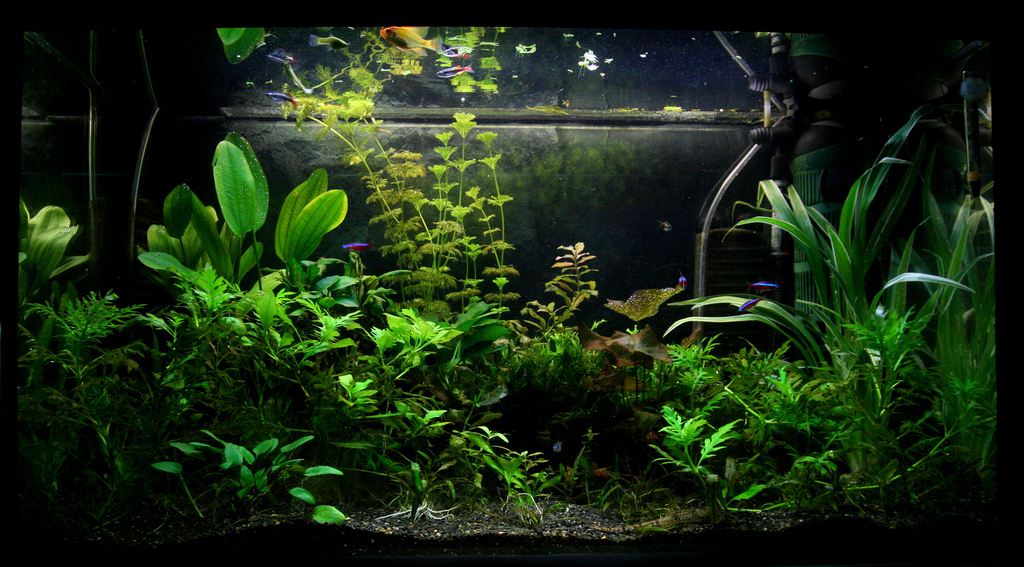
Build the floor into a jungle. Leaf litter is the single best addition, because it feeds the shrimp, shelters shrimplets, and suits the apisto's blackwater instincts at the same time. A scatter of indian almond and botanical leaves breaks down slowly into exactly the mess both animals want; our indian almond leaves for shrimp guide explains the tannins and dosing. Pile on moss over the top of that. A dense bed of live aquarium moss is a nursery no cichlid can get inside, and the best moss for shrimp tanks guide compares the options.
Give the fish its own caves. A spawning female that has a proper cave in a quiet corner stakes out a smaller patch than one forced to improvise, which keeps the shrimp no-go zone contained. Coconut huts, small clay caves, and driftwood tangles all work.
Run a sponge filter. A bare intake pulls shrimplets in, and a sponge filter avoids that while growing the biofilm shrimp graze. If you run a canister or hang-on-back, cap the intake with a pre-filter sponge.
Add the fish to an established colony, never the reverse. Let the shrimp breed in a planted tank for a couple of months first, then introduce the apisto. A big head-start population absorbs the losses while still coming out ahead.
One warning on health. If an apistogramma shows ich or another parasite, do not reach for copper-based medications while shrimp are in the tank. Copper kills invertebrates at doses fish shrug off. Treat the fish in a separate hospital tank, or use a shrimp-safe product, and check our shrimp-safe fish medications notes before dosing anything.
Signs the Pairing Isn't Working
Most of the time an apisto settles in and patrols its patch while the colony ticks along. Watch for these before you assume all is well.
- •Your adult shrimp count is falling, not just the babies. A dwarf cichlid cannot eat grown shrimp, so vanishing adults point to water quality or a parameter swing, not the fish. Test the water first.
- •You never see a single juvenile despite berried females. In a thinly planted tank the apisto is clearing shrimplets faster than they can hide. Add moss and leaf litter before giving up on the fish.
- •One corner has become a shrimp dead zone with a fish parked in it. That is a breeding female guarding fry. It passes when the brood disperses, but a very small tank may need the pair separated.
If adults are disappearing, a readable ammonia or nitrite level or a hardness crash does the damage far more often than any tankmate. Our cherry shrimp care guide covers the colony basics if the numbers are still settling.
Frequently Asked Questions
◆Will an apistogramma eat cherry shrimp?
It will not eat adult cherry shrimp, which are too big for its small mouth, but it readily eats shrimplets and freshly molted shrimp because it forages along the bottom where they hide. In a heavily planted tank enough babies survive that the colony can still grow, just more slowly.
◆Are apistogrammas or german blue rams better with shrimp?
Both can work in a planted tank, but they fail differently. The apistogramma is hardier and hunts the substrate, so it thins shrimplets harder. The ram wants hotter water that stresses neocaridina. For a neocaridina colony, a cooler-tolerant apistogramma like the borellii is often the easier match.
◆What is the most shrimp-friendly apistogramma?
Apistogramma borellii, the umbrella cichlid, comes up most often. It stays small, is listed as peaceful, and tolerates a cooler, wider water range that overlaps a neocaridina tank. The cockatoo, A. cacatuoides, is the other common pick because it is hardy and adapts to neutral water.
◆Can I breed shrimp in a tank with an apistogramma?
Not reliably. You can keep a steady display colony if the tank is planted and the shrimp got a head start, but you will lose most broods to the fish, and a spawning female drives shrimp off entirely. For raising shrimplets to sell or trade, use a separate tank with no fish.
The Bottom Line
An apistogramma and a shrimp colony can share a planted tank, as long as you go in wanting a display rather than a nursery. Adult neocaridina and amano shrimp are too big to eat, so they hold up. Shrimplets feed the fish, because these dwarf cichlids hunt the same bottom the babies live on, and a breeding female turns ferocious for a while each brood. Pick a calmer, cooler-tolerant species like the borellii for a cherry colony, bury the tank in moss and leaf litter, give the fish its own caves, and add it to an established colony. For the wider stocking question, our best tank mates for cherry shrimp guide ranks the safer choices against the risky ones.
Found this helpful?
Check out our other shrimp care guides