Can Shrimp Live With Scarlet Badis? An Honest Nano Tank Answer
Can shrimp live with scarlet badis? Adult shrimp are too big for this tiny micro predator, but it hunts shrimplets, so cover and feeding decide it.
📅 Published 2026-11-02
The scarlet badis keeps showing up in shrimp-keeper circles, and for a good reason. It is tiny, it is one of the most colorful nano fish you can buy, and it stays small enough to live in the same five or ten gallon planted tank a cherry colony is already in. Then you read the word predator, and the plan stalls.
The honest answer is that this pairing works more often than it fails, but it comes with one catch most tankmate articles skip. A scarlet badis cannot eat an adult shrimp, so your grown stock is safe. It can and will hunt shrimplets, and whether that matters comes down to two things you control: how much cover the tank has, and how well you feed the fish. This guide covers what the fish is, what it actually eats, how it stacks up against a dwarf cichlid like the ram, and how to set a tank up so a colony keeps growing underneath it.
Quick Answer
Yes, shrimp and scarlet badis can share a planted nano tank, and a lot of keepers run exactly this combination on purpose. Adult neocaridina and amano shrimp are too big to fit in the fish's mouth, so they come through fine. The risk is aimed squarely at shrimplets and freshly molted shrimp.
Two things decide how well it goes. The first is cover. A scarlet badis is a slow, short-range hunter, so a tank packed with moss, leaf litter, and plants lets most babies survive out of its reach, and the colony holds steady or climbs. The second is feeding, and this is what makes the badis different from almost any other tankmate. It will not touch flake or most pellets, so it lives on small live and frozen foods, which means a well-fed fish hunts less and a hungry one in a bare tank picks the colony apart. Feed it properly and plant the tank heavily, and you can keep both. If you want to raise every shrimplet to sell or trade, give the shrimp their own tank.
What a Scarlet Badis Actually Is
Scarlet badis, Dario dario, belongs to the family Badidae and comes from the tributary streams that drain into the Brahmaputra River in the Indian states of West Bengal and Assam, and possibly into Bhutan. In the wild it lives in shallow, clear, slow water over sand and gravel, with thick plant growth along the banks and in the water itself. That habitat tells you most of what it wants in a tank: clean soft water, gentle flow, and a lot of plants to hide in.
It is one of the smallest fish of its kind. Wikipedia puts adult males at usually no more than 2 cm, about 0.8 inch, with females smaller at around 1.3 cm, and lists it among the smallest percoid fishes known. Seriously Fish gives a maximum of 20 mm standard length, which is the body measured without the tail. Either way you are dealing with a fish the size of a fingernail, and that size is the whole reason this pairing is possible. A mouth that small cannot do anything to a grown shrimp.
The fish earns a living as a micropredator. Both Wikipedia and Seriously Fish describe Dario species feeding on small aquatic crustaceans, worms, insect larvae, and other zooplankton. It is built to pick tiny moving things out of the water and off surfaces one at a time, which, as you will see, is both why it leaves adult shrimp alone and why shrimplets are on the menu.
Temperament rounds out the picture. Seriously Fish calls the fish slow-moving with a retiring nature, and easily intimidated or outcompeted for food by larger or more aggressive tankmates. Males hold territories and can be aggressive toward each other in a small tank, but toward anything that is not another male badis they are shy rather than pushy. This is not a fish that chases shrimp around the tank. It waits and strikes at close range.
Will a Scarlet Badis Eat Your Shrimp?
◆Adult shrimp are too big
A grown cherry shrimp runs about an inch to an inch and a half. A scarlet badis tops out near 0.8 inch, with a mouth a fraction of that. There is no version of events where it swallows a healthy adult shrimp, and keepers who run the combination report the fish ignoring grown shrimp once it settles in. Amano shrimp, which reach about two inches, are safer still, and several care guides name adult amanos as a shrimp a badis simply cannot bother.
The one soft spot is a shrimp in the first hour or two after a molt, when it is pale and soft and hiding. Good cover handles that, because a shrimp that just molted is already tucked away where the fish cannot reach it.
◆Shrimplets are the real question
Here is where the honest answer lives. A newborn shrimp is a two millimeter speck, which is exactly the size of prey a micropredator hunts in the wild. A scarlet badis will eat shrimplets if it finds them in the open. The fish is not being mean about it. Hunting tiny moving prey is just what it does.
What saves a colony is that the badis is a poor long-range hunter. It does not patrol or dig. It waits and strikes at short range, so babies that stay inside moss, leaf litter, and dense planting are out of its world. In a bare tank with a few plastic plants, the fish picks off most of the young. In a thicket of java moss and botanicals, enough survive to keep the colony growing, just more slowly than it would with no fish at all.
◆Why the sources disagree
Care guides split on how much to worry, and it helps to see the split rather than pick one side. On the optimistic end, one guide notes the badis may occasionally eat newly hatched cherry shrimp but that the young outgrow the risk after a few weeks, and that a healthy colony produces more babies than a single small fish can eat. On the cautious end, another warns that a badis will hunt down shrimplets and, if hungry and bold enough, may even take a full-grown shrimp, and calls it a poor choice for a breeding tank on that basis.
Both can be true in different tanks. The optimistic version is what you get with a mature, crowded colony in a heavily planted tank where the fish is well fed. The cautious version is what you get with a few shrimp in a sparse tank where the badis is hunting because nothing else is feeding it. The gap between those two outcomes is cover and food, which is the next section.
The Feeding Catch That Decides It
Most tankmate guides stop at "it eats babies." The scarlet badis has a second trait that matters just as much, and it cuts both ways.
This fish refuses dried food. It usually will not take flake at all, and it takes pellets only grudgingly, if they are small and still sinking. In practice you feed a scarlet badis small live or frozen foods: baby brine shrimp, Daphnia, grindal and micro worms, and similar tiny invertebrates. Seriously Fish adds a warning to go easy on bloodworm and tubifex, because badids tend to put on weight and run into health trouble on them.
That one fact drives the whole shrimp question. A badis that gets a regular feeding of live or frozen food is a fed fish, and a fed fish ambushes far fewer shrimplets than a hungry one hunting out of need. Your feeding discipline is the single biggest lever you have over shrimp losses. Skip feedings and the fish turns the nursery into a buffet.
The flip side is competition. A scarlet badis and a tank full of shrimplets are after some of the same things: the small live foods you add, and the natural microfauna that grows in an established tank. The fish mostly ignores the algae wafers, biofilm, and plant-based foods your shrimp graze, so the two are not fighting over the shrimp menu. But a target-fed portion of frozen Daphnia is food the badis wants and the shrimp will scavenge too, so feed enough that the fish gets its share and some still sinks for the colony. A pack of frozen Daphnia or baby brine shrimp is the staple to keep on hand.
Scarlet Badis vs German Blue Ram for a Shrimp Tank
People reach for a ram when they want a small, colorful centerpiece over a shrimp colony, so the two fish get compared a lot. They fail a colony in different ways. Our guide to shrimp and german blue rams covers that fish in full; this table lines the two up.
| Trait | Scarlet badis | German blue ram |
|---|---|---|
| Adult size | About 0.8 in, one of the smallest nano fish | About 2 to 2.5 in |
| How it hunts | Short-range ambush in and around cover | Mid-water, cruising |
| Threat to adult shrimp | None, mouth far too small | Low, but can harass small adults |
| Threat to shrimplets | Real, eats what it finds in the open | Real, snaps at babies in open water |
| Diet catch | Refuses dry food, needs live or frozen | Takes prepared food readily |
| Temperature need | 64 to 79 F, cool to moderate | 80 to 86 F, warm end |
| Hardiness | Moderate, sensitive to swings | Low, often weak stock |
The ram's problem with a neocaridina colony is heat: it wants water at the top of what cherry shrimp tolerate. The badis asks for cooler water that overlaps a cherry tank well, and its mouth is far too small to threaten adults. The badis trade-off is the feeding effort, not the water.
Water: Where the Fish and the Shrimp Line Up
Water chemistry is usually where a fish and a shrimp colony clash, and this is one case where they mostly agree, with a caveat on the numbers.
For the fish, Wikipedia and Seriously Fish both give a broad range: temperature 18 to 26 C, roughly 64 to 79 F, pH 6.5 to 8.5, and hardness 1 to 15 dGH. Plenty of retailer care sheets quote a narrower comfort band, closer to pH 6.5 to 7.5 and the warmer half of that temperature range. That is a real disagreement, not a rounding error. The species-database range is what the fish can live across; the narrower retail range is where it tends to look and behave best. Read it as: aim for the middle, keep it stable, and you are fine either way.
Now set that against your shrimp. Neocaridina, the cherry family, want roughly pH 6.5 to 8.0 and 4 to 8 dGH, which sits right inside the badis range. The overlap is good. Our shrimp water parameters guide gives the full numbers, and the cooler temperature the badis prefers is a bonus for a cherry colony, because neocaridina live longer and breed steadily in cooler water than most people give them.
The one group to think harder about is high-grade caridina, the crystal reds and bee shrimp, which want genuinely soft, acidic water. That chemistry suits the fish too, but caridina are delicate and expensive, which is a poor thing to keep in front of a predator. If you keep pricey caridina, keep them in their own tank.
Which Shrimp Give You the Best Odds
If the tank is planted and the fish is fed, the shrimp side comes down to size and value.
Amano shrimp are the safest choice. At about two inches they are far beyond anything a scarlet badis can eat, and they do not breed in freshwater, so there are no shrimplets to lose. Our amano shrimp care guide covers them. The catch is that you get cleaners, not a growing colony.
Adult neocaridina work well for a display. Start with a mature, crowded colony, pick a hardy color line like a plain cherry or a blue dream, and accept that you are keeping a steady population rather than a breeding one. Enough babies survive in a planted tank to keep the numbers up.
Nerite snails sit alongside either and are completely ignored, since a badis has no interest in a hard-shelled snail, and they do not breed in freshwater to add prey.
The combination to avoid is a predator over a thin colony you are counting on to multiply fast. If growth is the goal, read our how to raise shrimplets guide and use a separate grow-out tank with no fish in it.
How to Set Up a Tank Where Both Thrive
A few choices separate a growing colony from a shrinking one.
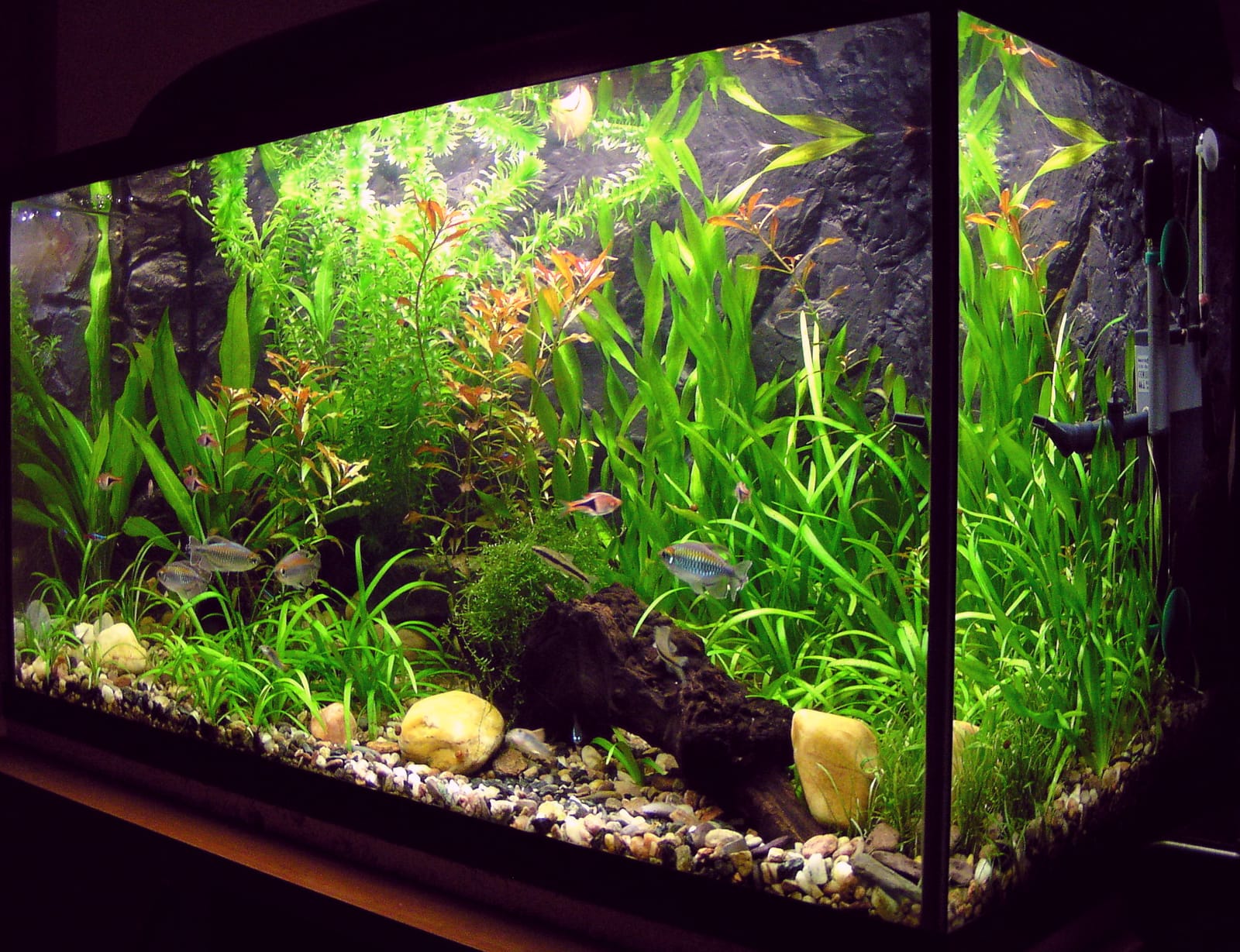
Plant it like a thicket. Moss is the best single thing you can add, because it is a nursery a fish this size cannot get inside. A dense bed of live java moss over driftwood gives shrimplets somewhere to spend their first weeks out of reach, and it suits the badis too.
Add leaf litter and botanicals. A scatter of leaves feeds the shrimp as it breaks down, grows the microfauna the fish hunts, and matches the badis's shaded, soft-water home. Our best tank mates for cherry shrimp guide ranks safer and riskier fish if you want to stock more.
Start with an established colony. Let the shrimp breed in a planted tank for a couple of months before the fish goes in. A big head-start population absorbs the losses and still comes out ahead.
Feed the fish on a schedule. This is the part people underfeed. A scarlet badis needs small live or frozen food several times a week, and a fish that eats well leaves shrimplets alone far more than one foraging because it is hungry.
Run a sponge filter. A bare intake pulls shrimplets in, and a sponge filter avoids that while growing the biofilm shrimp graze. The gentle flow also suits a fish that comes from slow streams.
One health warning. If the badis shows ich or another parasite, do not reach for copper-based medications while shrimp are in the tank. Copper kills invertebrates at doses fish shrug off. Treat the fish in a separate hospital tank, or use a shrimp-safe product.
Signs the Pairing Isn't Working
Most of the time the fish settles into a corner and ambushes what drifts past while the colony ticks along. Watch for these before you assume all is well.
- •Your adult shrimp count is dropping, not just the babies. A scarlet badis cannot eat a grown shrimp, so vanishing adults point to water quality or a parameter swing, not the fish. Test the water first.
- •You never see a juvenile despite berried females. In a thin tank the badis is clearing shrimplets faster than they can hide. Add moss and leaf litter, and feed the fish more, before you give up on it.
- •The fish looks washed out and skittish. A stressed badis in bright light with no cover loses its color, which usually means it needs more planting, not that the shrimp are the problem.
If adults are disappearing, a readable ammonia or nitrite level does the damage far more often than any tankmate. Our cherry shrimp care guide covers the colony basics if the numbers are still settling in.
Frequently Asked Questions
◆Will a scarlet badis eat cherry shrimp?
It will not eat adult cherry shrimp, which are far too big for its tiny mouth, but it will eat shrimplets and newly molted shrimp it finds in the open. In a heavily planted tank with a well-fed fish, enough babies survive that the colony still grows.
◆Are scarlet badis or german blue rams better with shrimp?
Both can work in a planted tank. The badis is smaller and cooler-running, so it never threatens adult shrimp and its water needs overlap a cherry colony better. The ram takes prepared food easily, while a badis needs live or frozen food, which is the main extra effort.
◆Do scarlet badis need live food?
Mostly, yes. Scarlet badis usually refuse flake and take pellets only reluctantly, so a diet of small live or frozen foods like baby brine shrimp and Daphnia is close to required. A badis that is fed well also hunts far fewer of your shrimplets.
◆How many scarlet badis can I keep with shrimp in a 10 gallon tank?
A planted 10 gallon suits one male with two or three females, or just a single fish. Rival males fight in tight spaces, so add more males only in a longer tank where each can hold its own territory. Fewer fish also means less pressure on shrimplets.
The Bottom Line
A scarlet badis and a shrimp colony can share a planted nano tank, as long as you go in wanting a display rather than a nursery. The fish is far too small to touch adult neocaridina or amano shrimp, so your grown stock is safe. Shrimplets are fair game, but a short-range ambush hunter clears far fewer of them in a tank buried in moss and leaf litter, and a badis that gets its live or frozen food several times a week has little reason to hunt babies at all. Plant it heavily, feed the fish on a schedule, start with an established colony, and the two get along. For the wider stocking question, our best tank mates for cherry shrimp guide ranks the safer choices against the risky ones.
Found this helpful?
Check out our other shrimp care guides