How Long Can Shrimp Go Without Food? Vacation Feeding Without the Risk
How long can shrimp go without food? Two weeks or more in a mature planted tank. When that isn't true, what to do before a trip, and why feeder blocks backfire.
📅 Published 2026-10-14
You've got a flight on Friday and a tank full of cherry shrimp that nobody's going to feed until you're back. The instinct is to buy a vacation block, or set up an automatic feeder, or ask a neighbor to drop in a wafer a day. All three are more dangerous to the shrimp than the thing you're worried about.
How long can shrimp go without food? In a mature planted tank, longer than your vacation. Dwarf shrimp graze biofilm and algae all day, the tank grows both without you, and a week or two of no wafers is a non-event. This guide covers where that stops being true, what to actually do the week before you leave, and why the vacation products aimed at fish keepers are a bad fit for a shrimp tank.
Quick Answer
Healthy dwarf shrimp in an established, planted tank can go one to two weeks without added food and not notice, and keepers with well-aged tanks report much longer. Shrimp Science and Pete's Aquatics both put the comfortable limit at about two weeks; a Fishlore thread splits it into roughly a week for a bare tank and two weeks where there's leftover food and algae to graze.
The exceptions are tanks with nothing to graze: a bare quarantine or breeder box, a tank set up in the last two months, or a heavy colony that has already stripped the surfaces clean. For those, and for any trip past two weeks, plan food. For everything else, the pre-trip work is a water change, a couple of leaves, and putting the feeder tub back in the cupboard.
Why Mature Tanks Feed Themselves
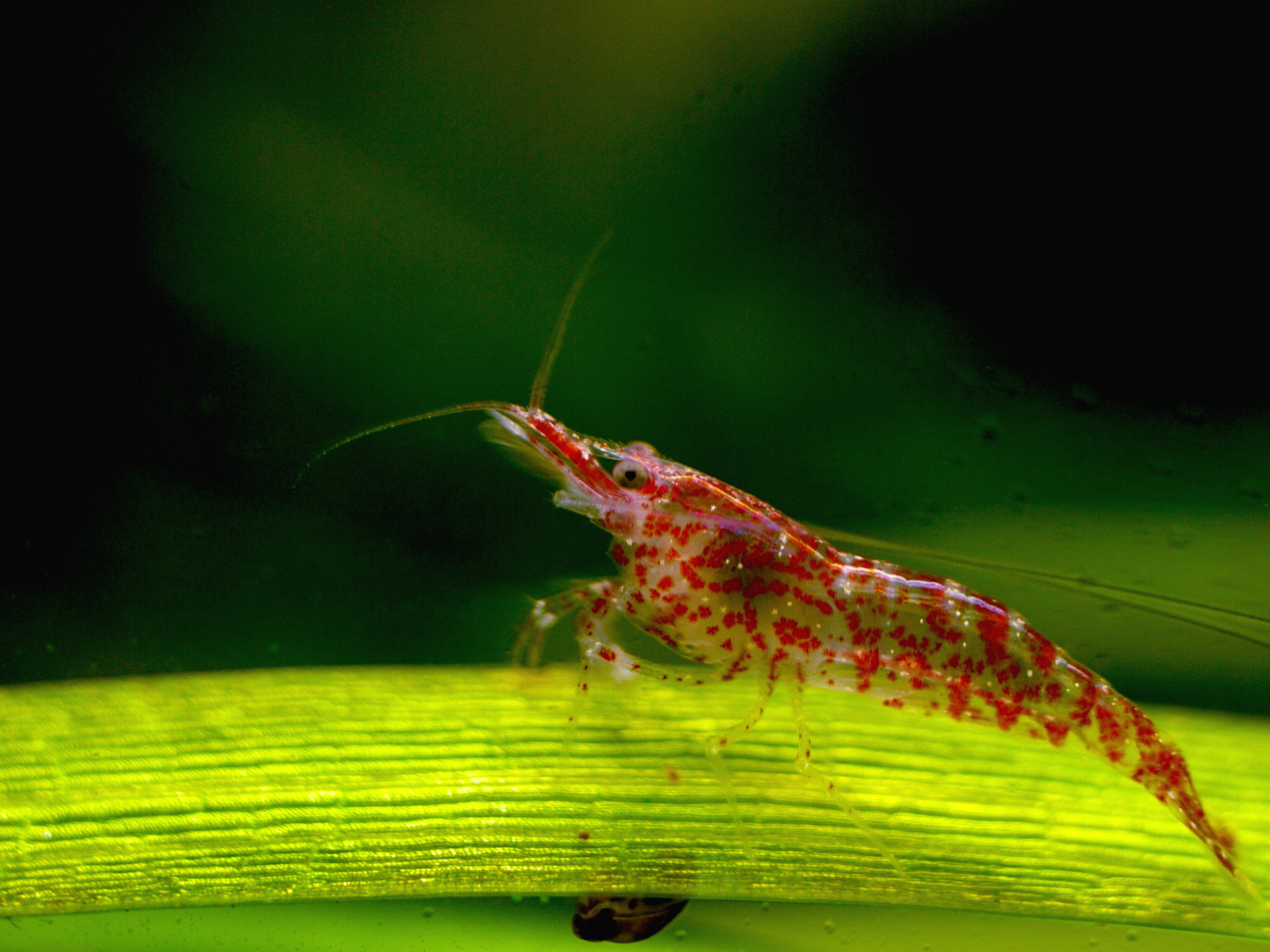
Watch a cherry shrimp for thirty seconds. Its front legs are picking at whatever it's standing on the entire time. That's biofilm, the coating of bacteria, microalgae, and fungi that grows on every wet surface, and it's most of a dwarf shrimp's diet whether or not you ever open a food tub. Shrimp Science describes biofilm as "a battery for your shrimp," a store of food that discharges slowly, and The Shrimp Farm's cherry shrimp feeding guide says the algae in a normal aquarium "is enough food to support a moderate Cherry Red Shrimp population" without supplements.
Wafers and pellets are a top up. In a tank with plants, some driftwood, a few leaves on the bottom, and a light on a timer, the top up is the part you can skip. On a Fishlore thread about leaving a shrimp tank for 18 days, one long-time keeper mentioned running eight shrimp tanks and never feeding two of them at all. An anecdote, not a plan, but the right mental model: the tank is the food, and you're the garnish.
The reason this works for shrimp better than for fish is size and metabolism. Aquarium Co-Op's vacation guide says adult fish can usually manage a week without food. A shrimp weighs a fraction of a gram, grazes continuously, and lives on a surface that regrows its food. That's also why shipping works: shrimp routinely spend one to two days in a bag with nothing but a leaf, and keepers on The Planted Tank forum have reported international shipments surviving 10 to 14 days in breather bags. Don't test that at home, but it tells you what the animal can take.
When Fasting Is a Real Risk
The "two weeks is fine" rule has a hidden condition: there has to be something to graze. Here's where that fails.
A new tank. Biofilm starts growing within days, but Shrimp Science says it takes "a few weeks before it builds up to a useful quantity," and Shrimp and Snail Breeder describes tanks that have been "up and running for months" as the ones where you can cut feeding to every few days. A tank set up six weeks ago with fresh substrate and new plants doesn't have the reserve. If you're leaving within the first two or three months, treat it as a bare tank.
A bare tank. Quarantine tubs, breeder boxes, and hospital tanks have no substrate, no plants, and no algae film to speak of. The Fishlore thread above was started by someone keeping new cherries in a breeder net with no gravel under them, and the honest answer there was "feed them, there's nothing else to eat." A bare tank needs food every day or two, trip or no trip.
A big colony. Pete's Aquatics makes the point that more shrimp deplete natural food faster. A hundred adults in a 10 gallon can strip surfaces cleaner than the biofilm can regrow. If your shrimp swarm a wafer within a minute of it landing, that's a sign the tank isn't keeping up on its own, and it's also the tank most likely to run short while you're gone.
Shrimplets. Babies graze biofilm too, and in a mature tank that's what they eat anyway. The risk is the same as above: a bare or new tank has no film for them. Our how to raise shrimplets guide covers powdered foods, but the pre-trip answer is leaves and moss, which grow the film they need.
Caridina. Pete's Aquatics describes Caridina as more delicate than Neocaridina here. A crystal red tank is usually cleaner and more controlled, with less algae to graze, so judge the tank, not the species.
Trips over two weeks. Two weeks is where every source stops promising. Past that, you want a sitter or a plan, even for a mature tank, because the risk stops being food and starts being a heater, a filter, or a top-off.
What to Do the Week Before You Leave
The goal is to make the tank stable and self-feeding, and then stop touching it. Aquarium Co-Op's vacation guide does the maintenance 48 hours before departure so you can see everything is still running before you go; Shrimp Science's shrimp-specific version adds one rule that matters more than any other: "don't try anything new." No new fertilizer, no new food, no heater adjustment, no product you haven't run before.
- •Water change, a few days out. A normal-sized one with matched water, not a heroic 50 percent the night before. A big swing in TDS or temperature right before you leave is exactly the kind of stress you can't respond to. Our shrimp tank water changes guide covers matching.
- •Rinse the filter sponge in tank water. Both Aquarium Co-Op and Shrimp Science say to clean the filter if it's due, and a sponge that's about to clog is a bigger risk than an unfed shrimp.
- •Add leaves. Indian almond leaves, oak, or alder cones. Shrimp Science says leaf litter lasts "a very long time in the water, allowing your shrimp to feed for weeks," and Aquarium Co-Op's cherry care guide notes that catappa leaves and cholla wood grow a biofilm layer that feeds both adults and babies. Put one in a week ahead so it's already colonized, and one more the day you leave. A search for Indian almond leaves will turn up the standard packs. Our Indian almond leaves for shrimp guide covers dosing and the tannin question.
- •Top off and put a lid on. Shrimp Science recommends topping up with RO or distilled water and adding a lid to cut evaporation. Two weeks of evaporation in an open nano tank concentrates every dissolved solid in it; a lid solves that for free.
- •Feed normally, then stop. A regular feeding the day before you go. Not a double portion; uneaten food in a tank nobody's watching is the one way to turn a non-problem into an ammonia problem. Dwarf shrimp are, in The Shrimp Farm's words, "very sensitive to ammonia and nitrites," and a rotting wafer is a small ammonia source in a small volume of water.
- •Leave the light on its timer. Algae is shrimp food. A keeper on the Fishlore vacation thread was embarrassed by the algae on their glass; the replies pointed out it was the best vacation feeder they owned.
- •Long-lasting food, if you want a safety net. Snowflake food (soybean hull pellets) is the one prepared food both Shrimp Science and Fishlore keepers single out as safe to leave in, because it grows fungus the shrimp eat rather than rotting. Drop a few pellets in the day you leave. Skip anything that softens and dissolves.
If you've been dosing a biofilm powder like GlasGarten Bacter AE, keep dosing it at your normal rate in the weeks before the trip. Don't start it the week you leave; keepers on the SKF forum report overdoses fouling water, and an untested product before a trip breaks the "nothing new" rule.
Why Vacation Blocks and Auto Feeders Backfire
These products exist for fish tanks, and even there the reviews are grim. In a shrimp tank the math is worse: the animals need almost nothing, the water volume is small, and there's nobody home to notice a mistake.
◆Feeder blocks
The classic "weekend" or "7 day" block is a plaster or gel binder with a little food in it, designed to dissolve over days. Aquarium Co-Op's vacation guide says outright that they "cause ammonia spikes and algae blooms" and often dissolve into a cloud of particles. Fishlore has a thread titled as a warning about them: the original poster came home from a week away to measurable ammonia and a dead angelfish, another member tested a weekend stick in a tank before a trip and watched ammonia rise within 24 hours, and a third lost 74 of 80 crayfish hatchlings overnight after dropping in two betta vacation tablets. Blocks dissolve on their own schedule, not the shrimp's, and the leftovers rot.
For shrimp specifically, a block adds food to a tank that already had enough, and adds it in the one form (a slowly rotting lump on the substrate) that raises ammonia. There's no version of this that helps.
◆Automatic feeders
Auto feeders solve a different problem: a fish that needs a daily portion of pellets. A shrimp colony doesn't. And the failure modes are the ones a shrimp tank can't survive. Aquarium Store Depot's long-term review lists them: "they dump too much food, they jam up from humidity, or the timer drifts." Humidity is the killer in a covered tank; flake and fine granules absorb it, clump, and either block the outlet (fine, the shrimp were never hungry) or let go all at once (an entire drum of food in a 10 gallon). The same reviewer's line is worth repeating: in 25 years of running stores he's "seen more tanks trashed by auto feeders than by vacation neglect."
The other problem is dose. A shrimp colony's daily ration is a fraction of a wafer, and most feeders can't reliably meter a portion that small. If you must use one, run it for a full week before you go, watch what lands, and treat any food still on the substrate after a few minutes as too much. Better: don't.
◆Well-meaning sitters
A sitter who "knows fish" is the third way a vacation kills shrimp, because they feed like they'd feed fish. Aquarium Co-Op's advice is to pre-portion each day's food into a pill organizer so the sitter can't improvise, and to tell them a missed day is never made up with a double one. Fishlore keepers in the feeder block thread do the same with contact lens cases. For a shrimp tank the portions can be tiny or absent; the sitter's real job is to confirm the filter is bubbling, the heater light is cycling, and nothing's floating. Give them your number and a rule: if something looks wrong, don't add anything, just call.
Coming Home
Resume your normal schedule, not a catch-up feast. The shrimp have been grazing all along and a triple portion now is the same ammonia problem you avoided by leaving. Do your usual water change on your usual day, and expect the tank to look a little greener than you left it.
Shrimp that ignore food when you get back are normal, and it usually means the tank fed them well. If they're also still, pale, or hiding, work through our why are my shrimp not eating checklist, which covers the causes in order. A long, unfed stretch by itself rarely makes the list.
A Decision Table
| Your tank | Trip length | What to do |
|---|---|---|
| Mature (3+ months), planted, leaves or wood | Up to 2 weeks | Water change, add leaves, feed normally, leave |
| Mature, planted | 2 to 4 weeks | Same, plus a sitter checking equipment weekly with pre-portioned food |
| New (under 2 to 3 months), planted | Up to 1 week | Leaves and a few snowflake pellets; fine |
| New, planted | Over 1 week | Sitter with pre-portioned food every 2 to 3 days |
| Bare tank, breeder box, quarantine | Any | Sitter, or move shrimp into the main tank before you go |
| Heavy colony that strips wafers in minutes | Over 1 week | Leaves plus snowflake pellets, sitter for anything longer |
| Any tank, any length | Never | Feeder blocks, untested auto feeders, double portions before leaving |
Frequently Asked Questions
◆How long can cherry shrimp go without food?
In an established planted tank, one to two weeks without added food is routine and harmless, and some keepers with mature tanks feed rarely or never. In a new or bare tank with no biofilm or algae, plan on feeding every day or two, because there's nothing else to eat.
◆Can I use a vacation feeder block in a shrimp tank?
No. Blocks dissolve on their own schedule, add food a mature tank doesn't need, and are a documented cause of ammonia spikes and losses. Shrimp are more sensitive to ammonia than the fish those blocks were made for. Leaves and a couple of snowflake pellets do the same job without the risk.
◆Do I need an automatic feeder for shrimp?
Almost never. Shrimp graze biofilm continuously and a colony's daily ration is too small for most feeders to meter. Feeders also jam in humidity and can dump a whole drum at once. If you use one, run it for a week before the trip and watch the landing zone.
◆Should I feed shrimp extra before going on vacation?
No. Feed a normal portion the day before and stop. Extra food rots on the substrate and raises ammonia in a tank nobody is watching. Add an Indian almond leaf or two instead; they grow biofilm slowly for weeks.
The Bottom Line
A mature shrimp tank is a self-feeding system, and the honest answer to how long shrimp can go without food is "longer than you'll be gone." The dangerous vacation isn't the one where nobody feeds them; it's the one where a block, a feeder, or a helpful neighbor feeds them too much. Do a water change, drop in a leaf, put the lid on, and go. If you're not sure the tank is mature enough to carry them, our what do shrimp eat guide explains what they're actually living on, and it'll tell you whether yours has enough of it.
Found this helpful?
Check out our other shrimp care guides